

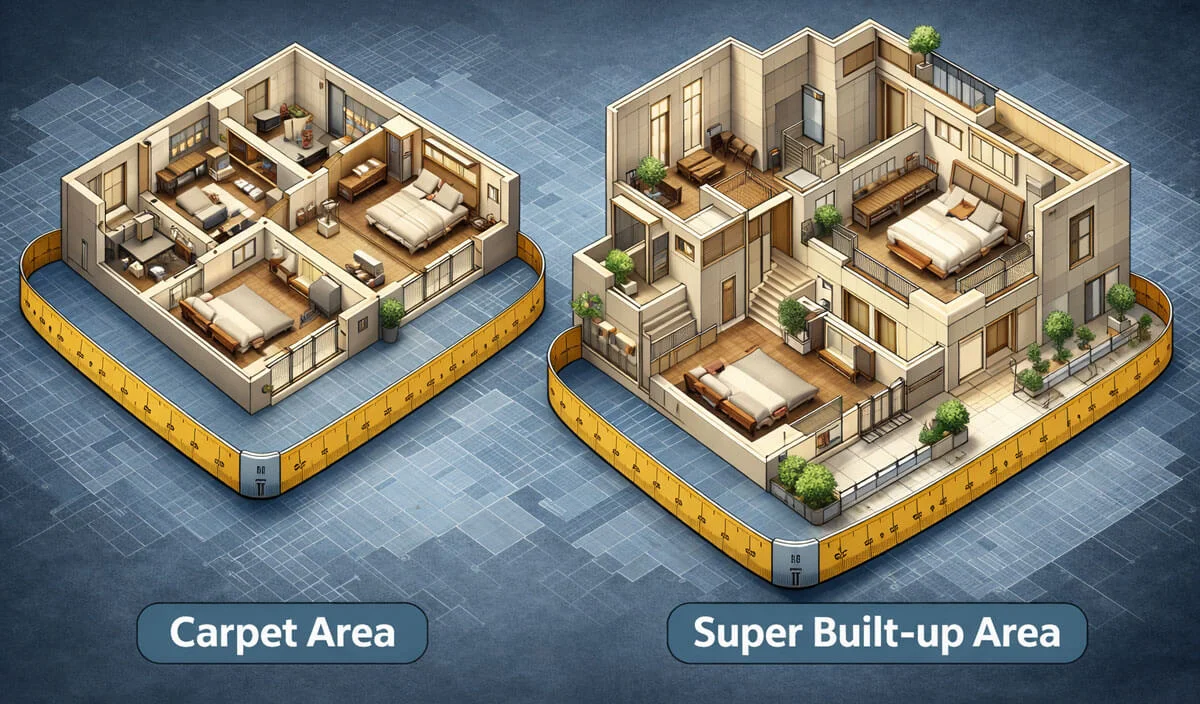
Quick Summary (Key Takeaways)
-
Carpet Area: The actual usable area where you can lay a carpet (net usable floor area).
-
Super Built-up Area (SBA): The saleable area, including walls, corridors, lobbies, and common spaces.
-
The Trap: Builders sell on SBA, but you live in the Carpet Area. The difference is the “Loading Factor,” which significantly inflates the cost. You can see how this impacts your final budget in our breakdown of the true cost of buying an apartment in India.
-
Your Right: Under RERA, if the actual carpet area is less than promised, the builder must refund the money with interest.
What is the Difference? (Comparison Table)
For a quick understanding, here is how the three main area types differ.
| Area Type | Definition | What it Includes | What it Excludes |
| Carpet Area | The net usable floor area of an apartment. | Bedroom, Living Room, Kitchen, Bathroom, Internal Walls. | External walls, Balconies, Service Shafts, Common Areas. |
| Built-up Area | The total area of the apartment unit. | Carpet Area + External Walls + Balconies + Utility Area. | Lobbies, Lifts, Stairs, Corridors. |
| Super Built-up Area (SBA) | The “Saleable Area” you pay for. | Built-up Area + Proportionate share of Common Areas (Lobby, Lift, Stairs, Clubhouse). | Roof rights (usually), Open Parking (varies). |
The Calculator: How to Calculate Super Built-up Area
Many homebuyers ask, “How much is the carpet area of the super built-up area?”
To find this, you need to understand the Loading Factor. This is the percentage of “dead space” (common areas) added to your apartment cost.
The Formula: Super Built-up Area = Carpet Area X (1 +Loading Factor)
Example Calculation: If you buy a flat with a promised 1000 sq. ft. Carpet Area and the building has a 30% Loading Factor:
-
Calculation: 1000 X (1 + 0.30) = 1300 sq. ft.
-
Result: You pay for 1300 sq. ft. (SBA), but you live in 1000 sq. ft.
Conversion Cheat Sheet
-
SBA to Carpet: If you only know the SBA (e.g., 1500 sq ft) and want to know the usable space, divide by roughly 1.35 (assuming 35% loading).
-
1500 / 1.35 ≈ 1111 sq. ft. Carpet Area.
-
Crucial: RERA Compensation for Carpet Area Shortfall
Targeting your top search query: “rera compensation for carpet area shortfall”
One of the most powerful protections for homebuyers today is the RERA Act (Real Estate Regulation and Development Act, 2016). While the act is central, specific implementations like RERA Karnataka protect homebuyers by enforcing strict penalties on builders who misrepresent data.
What if the actual area is smaller?
It is common to find that the apartment you received is smaller than what was shown in the brochure.
-
The Rule: According to Section 14(2) of the RERA Act, the promoter is liable to rectify any alterations.
-
The Refund: If there is a shortfall in the actual carpet area compared to the agreement for sale, the builder must refund the excess amount paid by the buyer along with interest.
-
Timeline: This compensation usually must be paid within 45 days.
Note: If the area is larger than promised, the builder can ask for extra money, but this is capped (often at 3%) depending on the specific Sale Agreement clauses.
Typical Carpet Areas in Bangalore & Mumbai (2026 Standards)
Based on recent market trends, here is what you should expect when looking for “typical carpet area for 1 bhk in Bangalore” or Mumbai.
| Configuration | Typical SBA (Saleable) | Typical Carpet Area (Usable) | Loading Estimate |
| 1 BHK | 600 – 800 sq. ft. | 380 – 450 sq. ft. | ~35-40% |
| 2 BHK | 1100 – 1300 sq. ft. | 750 – 850 sq. ft. | ~30-35% |
| 3 BHK | 1500 – 1800 sq. ft. | 1000 – 1200 sq. ft. | ~25-30% |
Note: In high-density cities like Mumbai, loading factors can often reach 45-50%, meaning the carpet area is barely half of the super built-up area.
Frequently Asked Questions (FAQ)
1. Does Super Built-up Area include parking? Generally, no. Open parking or stilt parking is usually sold separately as a “parking slot” right. However, the driveways and common circulation areas in the basement are often part of the Super Built-up calculation.
2. What is the difference between RERA Carpet Area and Usable Carpet Area?
-
RERA Carpet Area: Strictly net usable floor area excluding external walls, service shafts, and balconies.
-
Usable Carpet Area: Often cited by brokers, this might informally include the balcony and utility area to make the flat sound bigger. Always check the legal RERA definition in your agreement.
3. What is a “good” loading percentage?
-
0-20%: Excellent (Rare, usually older buildings).
-
20-30%: Good (Standard for premium projects).
-
30-40%: Average (Common in high-rise townships).
-
40%+: Poor (You are paying significantly for common spaces).
Conclusion: Check Before You Sign
Understanding the difference between Carpet Area and Super Built-up Area is your first line of defense against paying for space you don’t get. Before signing any agreement, always verify the “Loading Factor” and ensure the carpet area is explicitly mentioned as per RERA norms.
For a step-by-step guide on what else to look for during your purchase, refer to our Ultimate 100-Point Apartment Buying Checklist.


