

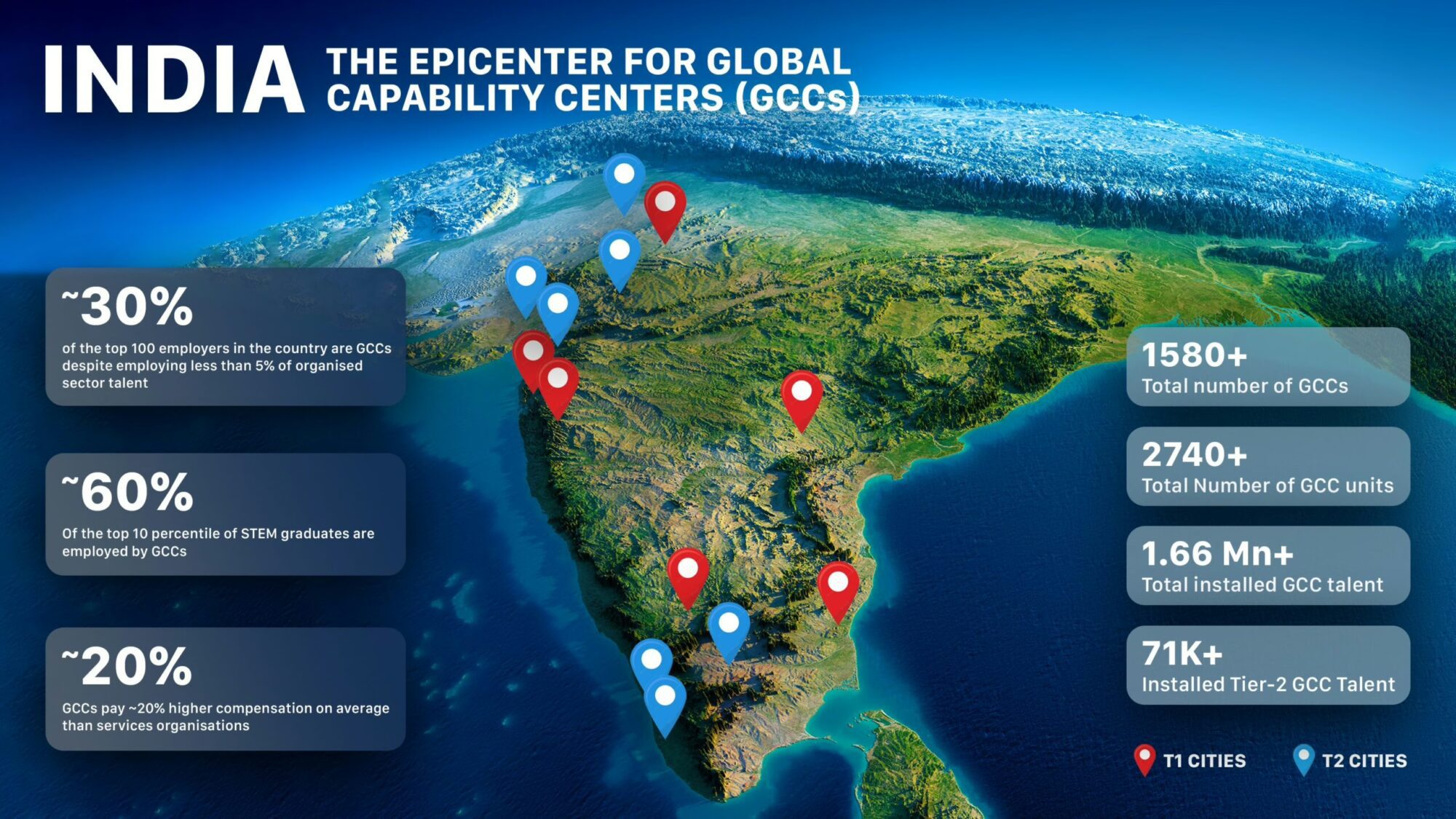
India’s commercial real estate sector is witnessing a new phase of expansion, powered significantly by Global Capability Centres (GCCs). According to a recent industry assessment, GCCs are set to lease an additional 50–55 million sq. ft. of Grade A office space during FY2026–FY2027. This surge is expected to account for nearly 40% of the total demand across India’s top six office markets.
Rising Role of GCCs in India’s Office Leasing
Global Capability Centres—specialized hubs that manage business operations, technology, and R&D functions for multinational corporations—have emerged as major contributors to India’s office leasing activity.
Currently, there are around 1,700 operational GCCs across the country. This number is projected to exceed 2,500 by 2030, highlighting India’s growing appeal as a destination for global enterprises seeking cost-efficient and skilled workforces.
The incremental office leasing activity led by GCCs is expected to reach 50–55 million sq. ft. between FY2026 and FY2027. This growth will contribute around 38–40% of overall office demand across top Indian cities. Industry estimates suggest that the revenue potential from GCCs could surpass $100 billion by 2030.
City-Wise GCC Leasing Trends
Among Indian cities, Bengaluru continues to dominate the GCC market, holding a 40% share in total GCC leasing. The city’s established IT ecosystem, robust infrastructure, and skilled talent pool make it a preferred choice for global firms.
Hyderabad follows with an 18% share, while Chennai accounts for 16% of the total GCC leasing. The National Capital Region (NCR), Mumbai Metropolitan Region (MMR), and Pune collectively account for the remaining 26%.
Moreover, nearly 65% of new leasing is taking place in green-certified and integrated tech parks, indicating a growing emphasis on sustainability and modern workspace environments.
Sectoral Evolution and Changing Occupier Mix
The GCC landscape in India has evolved beyond traditional back-office operations. The technology sector continues to dominate demand, but other industries are rapidly expanding their presence.
The engineering and manufacturing segment has seen its share rise from 12% to 25% between FY2018–FY2020 and FY2023–FY2025. Similarly, the BFSI (Banking, Financial Services, and Insurance) segment has grown from 15% to 21% during the same period.
In addition, GCCs are increasingly focusing on innovation, R&D, artificial intelligence (AI), and digital transformation. This shift underscores the strategic role of GCCs in driving high-value operations and technological advancements from India.
Workforce Expansion and Economic Impact
With the rapid expansion of GCCs, India’s workforce within this segment is projected to increase by 1.5 to 2 times by 2030. The combination of advanced skill sets, competitive costs, and favorable business conditions continues to make India a hub for multinational corporations setting up or scaling their global centers.
The growing presence of GCCs also supports the broader commercial real estate ecosystem—boosting demand for coworking spaces, built-to-suit offices, and sustainable workplace designs.
Global Origins of GCCs in India
Currently, US-based GCCs lead the market, accounting for nearly 70% of total office absorption since 2021. However, participation from other countries is also increasing, including the UK, Germany, France, Japan, Australia, and Singapore.
This expansion is driven by India’s skilled talent base, cost advantages, and policy support that promote foreign investments and business scalability.
India’s Competitive Edge in Office Rentals
India’s office space remains among the most cost-competitive globally. Grade A office rentals in prime commercial hubs range from $1–2 per sq. ft. per month, positioning India as a preferred location for global firms seeking large-scale operational efficiency.
The affordability of high-quality real estate, coupled with access to a large, tech-driven workforce, continues to strengthen India’s position as a key global hub for GCC expansion.
Outlook for the GCC-Led Office Market
The GCC-driven growth wave signals a structural transformation in India’s office real estate market. With strong leasing activity projected over the next two fiscal years, GCCs are expected to play a central role in shaping India’s next decade of commercial real estate development.
As global enterprises continue to invest in innovation and digital capabilities, the GCC ecosystem in India is set to expand further—creating opportunities for new business hubs, employment growth, and sustainable office infrastructure across major metropolitan regions.
Also Read: Impact of Navi Mumbai International Airport on Real Estate Market


