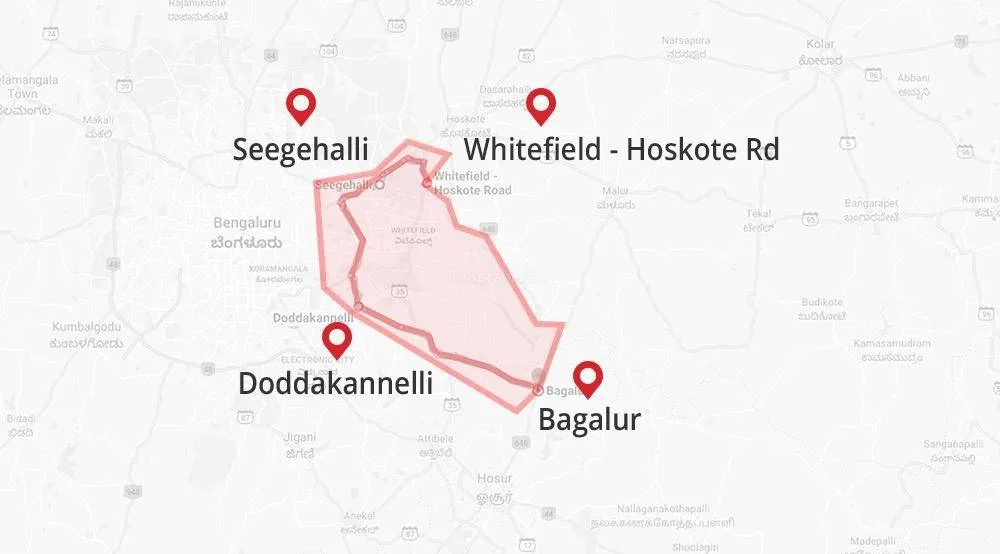
As India’s tech and urban landscapes evolve, Bengaluru is poised for another leap in infrastructure and neighbourhood development. The attached image highlights a newly-proposed growth corridor in and around Bengaluru — an area earmarked for future residential, commercial, and mixed-use expansion aligned with the city’s rising demand for space, connectivity, and live-work options. This blog explores the contours of this development, its implications, and how it integrates into Bengaluru’s wider urbanisation trajectory.
Mapping the Growth Corridor
The image reveals several key features defining the proposed corridor:
-
A major radial road or express-link connecting the city to outlying suburbs or peripheral zones.
-
Large parcels of land marked for development, possibly indicating residential clusters, township developments or mixed-use hubs.
-
Green belts or buffer zones alongside the transport infrastructure, indicating planning for sustainable growth.
-
Adjacency to existing infrastructure nodes — IT parks, educational campuses, transport terminals — suggesting the corridor builds on Bengaluru’s ecosystem.
Such a layout suggests that planners are focusing on connectivity, land scalability, and future-proofing urban expansion rather than purely densifying existing zones. For property developers, investors and urban residents, this gives a view of where growth may next concentrate.
Why This Matters for Bengaluru’s Real-Estate Landscape
-
Space Constraint Relief
Bengaluru’s core zones face increasing pressure: limited land supply, rising property prices, and traffic congestion. Growth corridors provide fresh land supply and alternative nodes for development, helping rebalance demand. -
Connectivity as Catalyst
The presence of a dedicated transport link often acts as the spine of growth. When a corridor includes major roads, expressways or metro/rail links, the adjacent areas tend to benefit from uplift in land value, infrastructure commitments and property interest. -
Mixed-Use Development Opportunity
The image suggests large tracts earmarked for more than just housing — commercial buildings, retail fronts, green amenities and integrated townships. Modern buyers and renters increasingly favour such ecosystems over isolated housing clusters. -
Real-Estate Investment Insight
For investors and developers: such corridors are often the next frontier. Early-entry land parcels, phased launches, and infrastructure-backed zones in such growth areas tend to deliver stronger value appreciation over time compared to saturated central zones.
Key Highlights
-
The corridor spans an approximate linear axis emanating from Bengaluru’s urban core towards outlying land zones.
-
The widths of marked zones suggest service roads, green buffers, multi-lane access — pointing to large-scale infrastructure rather than incremental roads.
-
The presence of multiple cluster nodes along the corridor implies the developer/planner intends decentralised hubs rather than a single linear expansion.
-
Surrounding land plots appear to be divided into manageable parcels, which suggests phased launches or a mix of development partners (residential + retail + office).
Implications for Stakeholders
Homebuyers & End-Users
For someone looking at housing options in Bengaluru’s fringe or upcoming zones, this corridor offers potential benefits: newer infrastructure, likely lower cost per sq ft compared to central zones, and designed live-work environments. That said, choosing developments where builders emphasise infrastructure delivery, transparency and future-proofing becomes critical.
Investors
Land or early-stage housing allocations along such a corridor can yield significant upside once infrastructure becomes operational and occupancy begins. However, investor due diligence must include infrastructure timelines, builder track-record, connectivity status and likely absorption.
Developers & Planners
For developers, such a corridor presents a blank canvas — the chance to build township-scale projects, leverage integrated amenities and establish strong brand presence. Planners need to ensure connectivity, utilities, sustainable design and stakeholder coordination (transport, civic, green space) to ensure long-term success.
Growth Challenges & Considerations
While growth corridors hold promise, they also carry risks:
-
Infrastructure delivery delays: If roads, utilities or transit links lag, the project’s appeal may suffer.
-
Speculative plots: Some parcels may be launched purely on hype; buyers should check approvals, builder credibility and infrastructure milestones.
-
Transport load: A corridor needs multimodal connectivity (road + rail + bus) to truly function; reliance on just one mode may limit appeal.
-
Environmental and civic readiness: Large-scale extension requires water, drainage, power, open-spaces and civic services — which sometimes lag expected delivery.
The image of Bengaluru’s upcoming growth corridor paints a picture of dynamic urban expansion — one where infrastructure, land-planning and modern mixed-use development converge. For a city that has led India’s tech story, this next phase offers both challenges and opportunities. For homebuyers, investors, developers and city planners alike, the key will be aligning decisions with infrastructure reality, builder delivery and real-world utility of the corridor.
With thoughtful execution, this growth axis could become one of Bengaluru’s signature development zones in the years ahead. For anyone tracking Karnataka’s property market or Bengaluru’s urban future, understanding these corridors is essential.
Also Read: Transforming Bengaluru’s Commute: Metro, Buses, and the 30-Minute Vision