

Bengaluru stands at a turning point in its urban story. Once known for its calm charm and green spaces, the city today battles endless traffic, air pollution, and an overstretched infrastructure system. Yet, beneath this chaos lies an opportunity — to rebuild Bengaluru’s mobility around people, not vehicles.
In a meeting with Deputy Chief Minister D.K. Shivakumar, Member of Parliament Tejasvi Surya presented the Alternative Sustainable Mobility Action Plan, a comprehensive blueprint designed to transform the city into a 30-minute metropolis. The vision is simple but ambitious: to create a city where every citizen can reach work, school, or leisure within half an hour, using safe, affordable, and sustainable transport.
The plan recognizes that the problem is not just congestion but a deeper flaw in urban philosophy. Bengaluru has been designed for cars, not citizens. Over the years, the city has relied heavily on road expansion and flyovers, expecting them to solve traffic jams. Instead, every new road has invited more vehicles. The absence of first- and last-mile connectivity, poor coordination among agencies, and delays in public transport projects have made the situation worse. The result is a car-dominated urban sprawl that leaves little room for people, cyclists, or buses.
The Tunnel Road Paradox
One of the central discussions in the plan is the comparison between the proposed Tunnel Road and the city’s Metro network. The data reveals a striking contrast. For every ₹1,000 crore invested, the Tunnel Road would move about 1,800 passengers, while the Metro could move nearly 69,000. In other words, the Metro is more than forty times more efficient in moving people per rupee.
The Tunnel Road would also charge a toll of around ₹330 for a one-way trip, while the average Metro fare remains below ₹60. Beyond the cost difference, the tunnel would create over 20 choke points at entry and exit ramps, add 2.5 extra kilometers per trip, and worsen air pollution. The project lacks an environmental impact assessment and soil or drainage studies, and assumes an unrealistic 50-month completion period.
Tejasvi Surya’s argument is clear — tunnel roads and double-decker flyovers are short-term fixes that lead to long-term problems. They move vehicles, not people. Cities that invested heavily in such projects, like Los Angeles and Seoul, have since reversed course, demolishing or abandoning them in favor of public transport and pedestrian-friendly planning.
Also read, GCCs to Drive the Next Growth Wave in India’s Office Market
A New Direction for Mobility
The Alternative Sustainable Mobility Action Plan sets out a five-part strategy that focuses on execution, integration, and human-centered design. The first priority is to improve the execution efficiency of ongoing projects like Metro and Suburban Rail instead of announcing new, uncoordinated ones. The second principle is to shift the city’s metrics from vehicle count to passenger movement per hour, emphasizing people over cars. The third pillar is to build a strong public transport backbone powered by Metro, Suburban Rail, Circular Rail, trams, and a modernized bus system. Fourth, the plan calls for complete integration across modes through unified ticketing and synchronized scheduling. Finally, it places pedestrians and cyclists at the heart of urban design, promoting transit-oriented development and walkable neighborhoods.
The 30-Minute City Vision
The plan’s grander vision is to make Bengaluru a 30-minute city, where daily needs, services, and jobs are all accessible within short travel times. It proposes a 317-kilometer Metro network operating at a three-minute frequency across all lines, supported by a city bus every five minutes, and pedestrian or cycling access within five minutes to the nearest public transport node. The goal is to achieve a 70 percent public transport modal share by 2031 as outlined in the Comprehensive Mobility Plan.
Smart zoning will bring homes, offices, and essential services closer together. Streets will be redesigned to prioritize people over vehicles. The city’s growth will focus on accessibility, not distance. Bengaluru, the plan says, must be built around people — not cars, not concrete, but community.
Immediate Measures for Today
While the long-term vision will take years to realize, the plan identifies immediate actions to relieve pressure on the city’s transport network. It calls for a permanent budget to procure 1,000 new buses every year with a daily operational subsidy of ₹1,000 per bus. The long-delayed ORR Bus Rapid Transit System must be approved and implemented without delay. Detailed project reports and tenders should be fast-tracked to avoid bureaucratic delays. The city also needs a Paid Parking Policy, removal of sidewalk encroachments, installation of cycle parking at government buildings and major public spaces, and the launch of Mission Great Roads and Mission Great Footpaths to ensure high-quality infrastructure.
Building the Street Network Bengaluru Needs
A key reason for Bengaluru’s traffic chaos is the absence of a defined road hierarchy. In most parts of the city, local streets feed directly into arterial roads like Outer Ring Road or Bellary Road, creating severe bottlenecks. Older neighborhoods such as Jayanagar and Vijayanagar have well-connected grids, but newer zones like Bellandur are built without secondary or collector roads. The plan recommends preparing a Street Network Plan to assign functional hierarchy — arterial, sub-arterial, and collector roads — and balance the movement of traffic across the city. Future developments must integrate clear road hierarchy and connectivity standards for smoother mobility.
Reviving BMLTA: One City, One Authority
Bengaluru’s biggest urban challenge isn’t just infrastructure but governance. To fix that, the plan proposes reviving the Bengaluru Metropolitan Land Transport Authority (BMLTA) as an independent, expert-led mobility regulator. This authority should oversee planning, funding, and coordination across all transport modes. All major projects should require BMLTA approval and must align with the Comprehensive Mobility Plan.
The proposal also calls for the creation of a Karnataka Urban Transport Service Cadre under the GBA to bring professional expertise into mobility management. A State Council of Town and Country Planners and a digital mobility platform would ensure data-driven decision-making and transparency. Integration across Metro, BMTC, Suburban Rail, Trams, Cycling, and Walking would finally give Bengaluru a unified and accountable mobility ecosystem.
Also read, The Future of East Bengaluru: Why All Eyes Are on Hoskote
The Public Transport Backbone
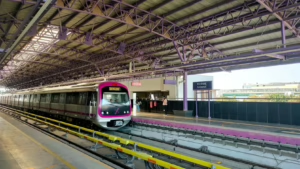
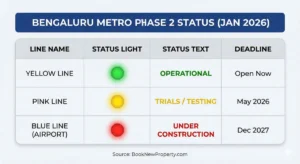
Public transport remains the core of the plan. The Metro must be expanded to its target of 317 kilometers, with a train every three minutes on all lines. Current progress stands at only 97 kilometers, highlighting the need for faster execution of Phase 2A, 2B, and Phase 3 corridors.
The Suburban Rail, with a target of 314 kilometers, can shift nearly ten lakh daily commuters from roads to rail if executed effectively. The plan urges a dedicated command center for K-RIDE, appointment of a full-time managing director from the Indian Railways Service, and integration of suburban stations with Metro and BMTC terminals.
Modern trams are also proposed as an affordable, zero-emission alternative for short-distance urban travel. Covering 100 kilometers across key corridors like Whitefield, KR Puram, Jayanagar, and Silk Board, trams could carry 12,000 to 15,000 passengers per hour at a fraction of the cost of Metro.
The BMTC, which carries over 45 lakh passengers daily, needs immediate attention. The current fleet of 7,000 buses falls far short of the CMP target of 16,500. The plan suggests expanding to 15,000 buses, supported by 4,500 e-buses under the PM e-Drive scheme, and allowing private participation to fill service gaps. Integration with the National Common Mobility Card will ensure seamless travel across all modes.
Roads, Footpaths, and Traffic Management
For road infrastructure, the plan proposes two flagship missions — Mission Sakkat Roads and Mission Sakkat Footpaths. The goal is to make every major road pothole-free using modern infrared bonded repair technology and to upgrade footpaths under Tender SURE Lite standards. Standardized road widths, consistent materials, and proper drainage will prevent choke points from returning.
The plan also advocates for synchronized traffic signals along major corridors like ORR, Bellary, Hosur, and Airport Road. Fifty of the most congested junctions will be redesigned to prioritize pedestrians and streamline traffic flow. Footpath parking will be strictly prohibited, and repeated violations penalized. A Joint Traffic Police–BBMP/BDA committee will meet monthly to review junction designs and signal timings.
Learning from Global Cities
Bengaluru is not the first city to face this challenge, and it can learn from others that have chosen a smarter path. Los Angeles scrapped its 710 Freeway Tunnel to reinvest in local public transport and neighborhood street upgrades. Seoul removed elevated roads like Cheonggyecheon Expressway to create pedestrian-friendly zones and enhance urban vitality. No Indian city has ever built a tunnel longer than five kilometers; Bengaluru’s proposed 18–20 km tunnel would be an untested, risky, and unsustainable experiment.
A City Moving Toward Connection, Not Congestion
The Alternative Sustainable Mobility Action Plan represents more than just a transport proposal. It is a shift in mindset — from congestion management to connection building. It calls for efficiency over expansion, execution over rhetoric, and sustainability over short-term populism.
At its heart is a belief that a better Bengaluru is not one where cars move faster but where people move freely. A city where walking and cycling are safe, public transport is dependable, and access to opportunity does not depend on owning a vehicle.
Tejasvi Surya summarized the vision simply: “Bengaluru doesn’t need short-term populism. It needs a long-term vision — one that builds a global city anchored in accessibility, equity, and sustainability. A city where every citizen moves freely, efficiently, and with dignity.”
The future of Bengaluru, this plan insists, lies not in its traffic lights or tunnels but in its people — and how freely they can move.
Also read, Why Kanakapura Road is Gaining Momentum for Affordable Plot Investments