Understanding Base Selling Price: The Foundation of Property Pricing in India
Base Selling Price represents a property’s foundational cost that developers or sellers list when putting it for sale, specified per square foot of the RERA carpet area. This fundamental metric serves as the starting point for all property transactions in India’s real estate market, yet it represents only a portion of what buyers ultimately pay.
This baseline rate functions as the primary figure at which properties are advertised and initially evaluated. However, understanding that BSP excludes numerous additional charges is crucial for accurate budget planning. The total all-inclusive cost often exceeds the quoted rate by 15-25%, depending on the project location, amenities and the developer’s policies.
What BSP Means for Property Buyers
The BSP encompasses two primary components. It covers the cost of the land plot, property construction, and other built-up area that a buyer has to pay for, along with a profit margin. This includes the Undivided Share (UDS) of land, which gives buyers legal rights to a portion of the land beneath the building, plus construction costs covering materials, labor, contractor margins, and developer profit.
How BSP is Calculated: The Mathematical Foundation
The RERA-Standardized Calculation Method
To calculate the BSP, one must multiply the property’s base price per square foot with its RERA carpet area. This standardization came into effect following the Real Estate (Regulation and Development) Act, 2016, which mandated that developers calculate pricing based on carpet area rather than super built-up area.
BSP Calculation Formula:
BSP = Base Price per sq. ft. × RERA Carpet AreaPractical Calculation Example
If you’re considering a 2 BHK home of 1200 sq. ft. super built-up area and the builder is quoting ₹7,500/sq. ft., then BSP = 7,500 × 1,200 = ₹90,00,000. However, this ₹90 lakh figure is merely the starting point, not the final amount buyers will pay.
For a more detailed breakdown, consider a 1,500 sq. ft. apartment with a base price of ₹10,000 per sq. ft.:
- RERA Carpet Area: 1,500 sq. ft.
- Base Price per sq. ft.: ₹10,000
- BSP = 1,500 × ₹10,000 = ₹1,50,00,000
This ₹1.5 crore represents only the foundational cost before any additional charges are applied.
Also read, Super Built-Up Area vs Carpet Area: How It Inflates Apartment Cost
The Evolution of Property Pricing: Pre-RERA vs. Post-RERA Era
Pre-RERA Pricing Practices
In earlier times, property pricing was less transparent, often leading to confusion and misinformation. Developers routinely quoted prices based on super built-up area, which could be 25-30% higher than carpet area, making properties appear more affordable than they actually were.
Post-RERA Transparency Standards
Under RERA, developers must now disclose BSP along with all other costs transparently, helping home buyers make informed choices. The Act, which came into force on May 1, 2017, mandates comprehensive project disclosures including land status, approvals, timelines, and most importantly, pricing based on carpet area.
The calculation has become far simpler now due to the RERA Carpet Area’s introduction, with developers required to register their projects with the Real Estate Regulatory Authority before advertising or selling properties.
Components Excluded from BSP: The Hidden Cost Reality
What BSP Does NOT Include
The quoted price excludes many components, such as registration charges, stamp duty, Preferential Location Charges (PLC), Infrastructure Development Charges (IDC), Electricity and Equipment Charges (EEC), Fire Fighting Charges (FFC), External Development Charges (EDC), Interest-Free Maintenance Security (IFMS), and more.
Understanding these exclusions is critical because they can add 15-25% to the advertised rate, and in some cases, push the total cost even higher.
Breakdown of Additional Charges Beyond BSP
Preferential Location Charges (PLC)
PLC refers to the additional cost imposed on properties located in more desirable areas within a project, including scenic views of parks, lakes, or cityscapes, corner units offering better ventilation and privacy, and direction-based charges for Vastu-compliant orientations.
Typical PLC Rates:
- Park/Garden Facing: ₹100-300 per sq. ft.
- Corner Units: ₹50-200 per sq. ft.
- Sea/Lake View: ₹200-500 per sq. ft.
Floor Rise Charges (FRC)
FRC refers to the incremental cost levied as you move higher in a building, typically charged as a fixed amount per floor because higher floors offer better views, more natural light, reduced noise pollution from ground level, and enhanced privacy.
Standard FRC Structure:
- Ground to 3rd Floor: No FRC or minimal charges
- 4th to 10th Floor: ₹25-50 per sq. ft. per floor
- Above 10th Floor: ₹50-100 per sq. ft. per floor
Infrastructure and Development Charges
External Development Charges (EDC) refer to fees levied by local authorities for the development of external infrastructure that supports a residential project, including roads, sewage systems, street lighting, and water supply networks beyond the project boundary.
Infrastructure Development Charges (IDC) cover internal infrastructure improvements within the project site, including construction of internal roads, water and power supply systems, and recreational amenities.
Typical Range:
- EDC: ₹50-150 per sq. ft.
- IDC: ₹40-100 per sq. ft.
Utility Connection Charges
External Electrification Charges (EEC) cover costs associated with connecting a residential project to the local power grid, including installation of transformers, substations, and electrical lines necessary for reliable electricity supply.
Common Utility Charges:
- EEC: ₹40-100 per sq. ft.
- Fire Fighting Charges (FFC): ₹50-100 per sq. ft.
- Water Connection: ₹20-50 per sq. ft.
- Power Backup Installation: ₹25,000-₹1,00,000
Parking and Amenities
Parking Costs:
- Covered Parking: ₹2,00,000-₹5,00,000 per space
- Open Parking: ₹50,000-₹2,00,000 per space
- Additional Parking Spaces: Premium charges apply
Amenity Charges:
- Clubhouse Membership: ₹50,000-₹2,00,000 (one-time)
- Gym and Pool Access: Included in maintenance or separate fee
- Landscaping and Common Areas: ₹30-80 per sq. ft.
Statutory and Legal Charges
Interest-Free Maintenance Security (IFMS) is a refundable deposit collected by developers to ensure the maintenance and upkeep of common areas and facilities within a residential complex.
Government-Mandated Costs:
- Stamp Duty: 3.5-12.5% of property value (varies by state and gender)
- Registration Fees: 1-3% of property value (Note: Karnataka has updated registration fees from 1% to 2%)
- GST: 1% for affordable housing (up to ₹45 lakhs), 5% for premium properties
- IFMS: Typically 1-2 months of maintenance charges
Real Cost Analysis: BSP vs. Total Property Cost
Comprehensive Cost Breakdown Example
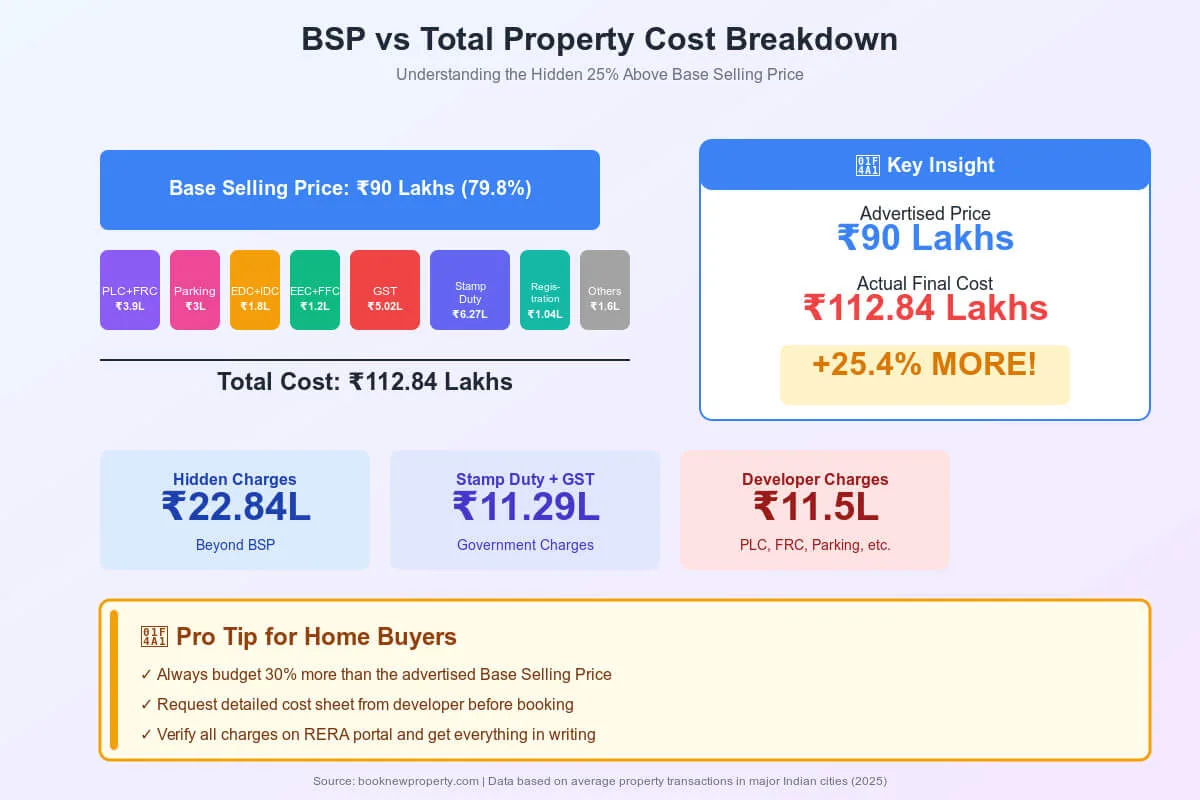
Let’s analyze a practical scenario where the quoted rate is ₹90 lakhs for a 1,200 sq. ft. apartment:
Base Rate: ₹90,00,000
Additional Charges:
- Preferential Location Charges (Park-facing): ₹2,40,000 (₹200/sq. ft.)
- Floor Rise Charges (8th floor): ₹1,50,000 (₹25/sq. ft. × 5 floors)
- Covered Car Parking: ₹3,00,000
- EDC + IDC: ₹1,80,000 (₹150/sq. ft.)
- EEC + FFC: ₹1,20,000 (₹100/sq. ft.)
- Clubhouse Membership: ₹1,00,000
- IFMS Deposit: ₹60,000
- GST @ 5%: ₹5,02,500 (on BSP + applicable charges)
- Stamp Duty @ 6%: ₹6,27,150
- Registration Fees @ 1%: ₹1,04,525
Total Cost: ₹1,12,84,175
This represents a 25.4% increase over the advertised rate, transforming a ₹90 lakh property into an actual investment of over ₹1.12 crores.
State-Wise Variation in Additional Costs
Additional charges can vary significantly across Indian states due to different stamp duty rates, local authority charges, and development regulations:
Metro Cities Comparison:
- Mumbai: Total additional costs typically 28-35% above quoted price
- Delhi NCR: Total additional costs typically 22-28% above quoted price
- Bangalore: Total additional costs typically 20-26% above quoted price
- Pune: Total additional costs typically 18-25% above quoted price
- Chennai: Total additional costs typically 17-23% above quoted price
BSP’s Role in Different Property Segments
Under-Construction Properties
For under-construction properties, BSP serves as the primary quoted price, but buyers face the highest number of additional charges. Developers often offer lower initial rates as incentives to early buyers, with more add-ons such as GST, PLC, IDC and others.
Key Considerations:
- GST applicable on construction value
- Construction-linked payment plans
- Risk of price escalation clauses
- Possibility of project delays affecting final costs
Ready-to-Move Properties
In ready-to-move properties, the pricing structure becomes more consolidated, with many development charges already absorbed. However, buyers must still account for:
- No GST (as property is completed)
- Higher stamp duty and registration fees
- Immediate maintenance charges
- Possession-related expenses
Affordable Housing vs. Luxury Segments
In the context of affordable housing, pricing plays a slightly different role, with affordable housing projects targeted at economically weaker sections and lower-income groups often having lower quoted rates compared to luxury or mid-segment properties.
Affordable Housing (up to ₹45 lakhs):
- GST: 1% (highly beneficial)
- Fewer premium charges (limited PLC, FRC)
- Government subsidies available under PMAY
- Simplified amenities package
Luxury Properties:
- Initial rates may seem competitive, but buyers should watch out for high add-ons like designer fittings, concierge services, premium parking, and smart home technology
- Higher PLC and FRC premiums
- Extensive amenity packages
- Premium finishes and specifications
Factors Influencing Property Pricing in Real Estate Market
Location and Connectivity
An area’s infrastructure development, public transport facilities, and connectivity are crucial factors influencing property rates, with closeness to educational and healthcare institutions, commercial hubs considerably impacting market valuation.
Location Impact on Pricing:
- Central Business Districts: 40-60% premium
- Proximity to Metro Stations: 15-25% premium
- Gated Communities: 10-20% premium
- Peripheral Areas: Base rates
Builder Reputation and Brand Value
Established developers command premium rates due to their track record, quality assurance, and brand credibility. Tier-1 developers typically charge 10-20% higher compared to emerging developers in the same locality.
Project Amenities and Specifications
The quality and extent of amenities directly influence pricing calculations:
Premium Amenities Impact:
- Clubhouse with extensive facilities: +8-12%
- Swimming pool and sports facilities: +5-8%
- Landscaped gardens and open spaces: +4-7%
- Smart home features: +3-6%
- Security systems and concierge: +2-5%
Market Demand and Supply Dynamics
The nation’s economic conditions and real estate sector’s general performance influence local market trends, with evolving tastes of homebuyers, such as rising preference for sustainable properties, also affecting property valuations.
Market Cycle Impact:
- Bull Market: Prices increase 8-15% annually
- Stable Market: Prices increase 3-6% annually
- Correction Phase: Prices may remain flat or decrease slightly
RERA’s Impact on Transparency and Disclosure
Mandatory Disclosure Requirements
RERA enforces strict rules on project advertisements, requiring developers to include the RERA registration number in all promotional materials and provide accurate information about project status, approvals, and completion timelines.
RERA Disclosure Mandates:
- Project Registration: All projects exceeding 500 sq. meters must be RERA-registered before marketing
- Carpet Area Specification: Pricing must be quoted on RERA carpet area, not super built-up area
- Cost Sheet Transparency: Developers must provide detailed breakup of all charges
- Quarterly Updates: Construction progress and financial utilization must be updated every three months
- Escrow Account: 70% of buyer funds must be deposited in project-specific escrow accounts
Consumer Protection Under RERA
Under RERA, developers must disclose all charges, including the basic rate, PLC, and FRC, to avoid disputes, with standardization mandating that these charges be clearly mentioned in the sale agreement. For buyers in Karnataka, understanding how RERA Karnataka protects home buyers is essential for making informed decisions.
Buyer Rights:
- Access to complete project information on RERA portal
- Legal recourse for false advertising or hidden charges
- Compensation for delays beyond promised timelines
- Five-year defect liability period from possession date
- Right to file complaints with state RERA authority
Penalties for Non-Compliance
Developers face significant penalties for RERA violations:
- Project registration without proper disclosures: Up to 10% of project cost
- Misleading advertisements: ₹10 crore or imprisonment up to 3 years
- Violation of financial discipline: Project deregistration and criminal proceedings
- Delay in possession without valid reason: Refund with interest or monthly compensation
BSP’s Influence on Home Loan Eligibility
Bank Valuation vs. Quoted Price
Banks usually assess the basic quoted rate (excluding taxes and government levies) when sanctioning the home loan amount, meaning buyers may need to pay for other components from their pocket.
Loan Calculation Example:
For a property with ₹90 lakh base rate and ₹1.12 crore total cost:
- Bank Valuation Base: ₹90 lakhs
- Maximum LTV: 80% (for loans up to ₹30 lakhs) or 75% (for loans above ₹30 lakhs)
- Loan Amount: ₹67.5 lakhs (75% of base rate)
- Buyer’s Contribution Required: ₹45.34 lakhs (₹22.5 lakhs down payment + ₹22.84 lakhs additional charges)
Impact on EMI Calculations
Since banks base loan amounts on the basic rate rather than total cost, buyers must carefully plan their finances:
Financial Planning Checklist:
- Calculate loan eligibility based on quoted rate
- Add 25-30% buffer for additional charges
- Arrange down payment (20-25% of quoted rate)
- Set aside funds for stamp duty and registration (8-12% of total cost)
- Budget for immediate possession expenses (interiors, utility deposits)
Tax Implications Related to Property Pricing
Capital Gains Tax Considerations
The stamp duty and registration fees are based on either the property rate or the circle rate, whichever is higher, with Capital Gains Tax at the time of resale also linked to the original purchase price. Understanding the complete property registration process in Karnataka can help buyers navigate these statutory requirements effectively.
Tax Calculation Scenarios:
Scenario 1: Purchase Price vs. Circle Rate
- Quoted Rate: ₹90 lakhs
- Total Cost Paid: ₹1.12 crores
- Circle Rate: ₹95 lakhs
- Stamp Duty Calculated On: ₹95 lakhs (higher of quoted rate or circle rate)
Scenario 2: Capital Gains on Sale
- Original Purchase Rate: ₹90 lakhs (2020)
- Selling Price: ₹1.5 crores (2025)
- Indexed Cost of Acquisition: ₹1.08 crores
- Long-term Capital Gains: ₹42 lakhs (₹1.5 cr – ₹1.08 cr)
- Tax @ 20% with indexation: ₹8.4 lakhs
GST Structure on Property Purchases
GST Rates Post-2019:
For Under-Construction Properties:
- Affordable Housing (up to ₹45 lakhs): 1% (no input tax credit)
- Non-Affordable Housing (above ₹45 lakhs): 5% (no input tax credit)
GST is calculated on the total transaction value, which includes the base rate plus applicable charges (PLC, FRC, parking, etc.), but excludes land value.
How to Verify and Negotiate Property Pricing
Due Diligence Steps Before Purchase
1. RERA Portal Verification:
- Check project registration status
- Verify approved layout plans
- Review quarterly progress reports
- Confirm completion timeline
- Check for any pending complaints
For a comprehensive approach to property evaluation, refer to our complete property buying checklist covering RERA, legal, and financial aspects.
2. Market Benchmarking: An extensive study of similar properties recently sold in a particular area can provide a close estimate of fair pricing, as researching sales history of comparable properties is a wise move.
Comparative Analysis Framework:
- Identify 5-7 comparable properties in same micro-market
- Compare per sq. ft. rates
- Analyze additional charges percentage
- Evaluate amenities and specifications
- Check possession timelines
3. Cost Sheet Analysis:
Request detailed cost breakdown from developer including:
- Basic rate with per sq. ft. calculation
- PLC with specific location advantages
- FRC structure and applicable floors
- All development charges (EDC, IDC, EEC, FFC)
- Parking and amenity charges
- Estimated GST, stamp duty, and registration
- Payment schedule with milestone linkage
Negotiation Strategies
While PLC and FRC are generally non-negotiable, buyers can request waivers or discounts, especially during pre-launch or inventory clearance sales.
Effective Negotiation Tactics:
- Pre-Launch Advantages: Developers offer 5-12% discounts during pre-launch phase
- Bulk Purchase: Buying multiple units can secure 3-8% overall discount
- Cash Payment: Lumpsum payment may get 2-5% reduction
- End-of-Quarter Deals: Developers meeting sales targets offer better pricing
- Inventory Clearance: Last few units in completed projects have highest negotiation leverage
Non-Negotiable Elements:
- Basic per sq. ft. rate (rarely negotiable)
- Stamp duty and registration fees
- Government-mandated development charges
- GST on construction value
Negotiable Elements:
- PLC rates (especially during slow markets)
- FRC waivers for specific floors
- Parking charges
- Clubhouse membership fees
- Payment plan structure
Common Mistakes Buyers Make with Property Pricing
Mistake 1: Treating Advertised Rate as Final Price
Many first-time buyers budget based solely on advertised rates, leading to funding gaps of 20-30%. Always add minimum 25% buffer over the quoted price for total cost estimation. To avoid such pitfalls, learn about common mistakes when investing in new launches and how to prevent them.
Mistake 2: Ignoring Carpet Area vs. Super Built-Up Area
Pre-RERA properties may still quote prices on super built-up area. Verify the measurement basis to avoid paying for inflated area calculations.
Mistake 3: Overlooking Hidden Charges
Charges which are not advertised are hidden costs such as maintenance charges, club membership, IDC and EDC. Request complete cost sheet in writing before booking.
Mistake 4: Not Factoring Possession Delays
Under-construction properties may face delays, leading to:
- Extended rent payments in current accommodation
- Pre-EMI interest accumulation
- Price escalation for pending payments
- Increased home loan interest rates
Mistake 5: Skipping RERA Verification
Buying from non-RERA registered projects eliminates legal protections. Always verify project registration before making any payment.
Property Pricing in Different Indian Cities: Regional Variations
Tier-1 Cities: Premium Markets
Mumbai Metropolitan Region:
- Average Rate Range: ₹15,000-₹40,000 per sq. ft.
- Additional Charges: 28-35% above base rate
- Primary Cost Drivers: Land scarcity, high stamp duty (6% for males, 5% for females), premium location charges
Delhi NCR:
- Average Rate Range: ₹8,000-₹18,000 per sq. ft.
- Additional Charges: 22-28% above base rate
- Primary Cost Drivers: Varied stamp duty across states (7% in Delhi, 7% in UP, 4-7% in Haryana), extensive EDC/IDC charges
Bangalore:
- Average Rate Range: ₹6,500-₹15,000 per sq. ft.
- Additional Charges: 20-26% above base rate
- Primary Cost Drivers: High IT demand, infrastructure development, moderate stamp duty (5% for all properties)
Popular projects in Bangalore’s premium segments include developments like Embassy Greenshore in Devanahalli and Brigade Eternia in Yelahanka, which showcase varied pricing structures across different micro-markets.
Tier-2 Cities: Emerging Markets
Pune:
- Average Rate Range: ₹5,500-₹12,000 per sq. ft.
- Additional Charges: 18-25% above base rate
- Growing IT hub with moderate pricing
Hyderabad:
- Average Rate Range: ₹5,000-₹10,000 per sq. ft.
- Additional Charges: 17-23% above base rate
- Government initiatives driving infrastructure
Chennai:
- Average Rate Range: ₹5,000-₹9,500 per sq. ft.
- Additional Charges: 17-23% above base rate
- Stable market with traditional demand patterns
Future Trends Affecting Real Estate Pricing
Technology Integration
Smart home features, IoT-enabled amenities, and digital infrastructure are becoming standard expectations, potentially increasing property rates by 3-7% for tech-enabled projects.
Sustainability Premium
LEED-certified and green buildings command 8-15% higher pricing due to energy efficiency, lower operational costs, and environmental consciousness among buyers.
Co-Living and Co-Working Spaces
New property formats are redefining pricing calculations, with shared amenities and flexible spaces creating different pricing models.
Government Policy Impact
Recent policy changes affecting pricing trends:
- PM Awas Yojana subsidies for affordable housing
- Smart Cities Mission infrastructure development
- Metro expansion projects increasing property values
- Real Estate Investment Trusts (REITs) bringing institutional investment
Expert Tips for Smart Property Investment
Investment Decision Framework
Step 1: Rate-to-Market Comparison
Calculate the variance between quoted rate and prevailing market rates:
- If quoted rate is 10-15% below market: Strong value proposition
- If it matches market: Fair deal, evaluate additional charges
- If it’s 5-10% above market: Premium may not be justified
Step 2: Total Cost Calculation
Use this formula for realistic budget assessment:
Expected Total Cost = Quoted Rate × 1.25 (for affordable housing)
Expected Total Cost = Quoted Rate × 1.30 (for mid-segment)
Expected Total Cost = Quoted Rate × 1.35 (for luxury segment)
Step 3: ROI Projection
Calculate potential returns considering:
- Annual appreciation rate (historical 6-10% in major cities)
- Rental yield potential (2-4% annually)
- Total holding costs (maintenance, property tax)
- Exit costs (capital gains tax, brokerage)
Red Flags in Property Quotations
Warning Signs:
- Unrealistically Low Rates: 20-30% below market may indicate:
- Legal or title issues with land
- Developer financial distress
- Hidden charges compensating for low rates
- Location disadvantages not disclosed
- Vague Cost Breakdown: Developer unwilling to provide detailed cost sheet before booking
- Frequent Price Revisions: Multiple price changes indicating unstable pricing strategy
- Pre-RERA Calculation Method: Properties still quoting on super built-up area instead of carpet area
- Non-RERA Registered: Lack of regulatory oversight increases risk exponentially
Conclusion: Making Property Pricing Work for Your Journey
Understanding Base Selling Price is not merely about knowing a real estate term—it’s about gaining financial clarity and making informed investment decisions in India’s complex property market. The BSP serves as the foundation, but recognizing that it represents only 70-80% of your actual expenditure is crucial for realistic budget planning.
The introduction of RERA has significantly enhanced transparency around pricing and associated charges, giving buyers unprecedented access to information and legal protections. However, due diligence remains the buyer’s responsibility. By thoroughly analyzing the quoted rate, verifying all additional charges, comparing market rates, and understanding regional variations, you can navigate property purchases with confidence.
Remember these key takeaways:
- BSP is the starting point, not the end point of property pricing
- Budget for 25-30% additional costs beyond the advertised rate
- Verify everything on RERA portal before making any payment
- Understand what’s negotiable and what’s mandatory in the cost structure
- Calculate total cost of ownership including loan eligibility and tax implications
Whether you’re a first-time homebuyer, an investor evaluating ROI potential, or someone upgrading to a larger property, mastering pricing analysis empowers you to make decisions aligned with your financial goals and expectations. In India’s evolving real estate landscape, knowledge of BSP and its comprehensive cost implications is your most valuable tool for successful property investment.
Frequently Asked Questions About Base Selling Price in Real Estate
Q1: Can developers change the quoted rate after booking? Under RERA regulations, developers cannot arbitrarily change rates after booking unless there are valid price escalation clauses mentioned in the agreement, which are now strictly regulated.
Q2: Is the initial payment refundable if I cancel the booking? Cancellation and refund terms depend on the agreement signed. RERA mandates that developers must refund the amount with interest if they fail to deliver, but buyer-initiated cancellations may attract penalties.
Q3: How does BSP differ from ready reckoner rates? Ready reckoner (circle) rates are government-notified minimum property values for stamp duty calculation. BSP is the developer’s quoted price. Stamp duty is calculated on whichever is higher.
Q4: Can I negotiate the quoted rate directly with the developer? While the base per sq. ft. rate is typically non-negotiable, you can negotiate overall cost through reduced PLC, waived charges, payment plan flexibility, or added amenities.
Q5: Does the basic rate include interior fittings? No, it covers only the basic shell including walls, flooring, plumbing, and electrical wiring. Interior design, modular kitchen, wardrobes, and furnishings are additional costs unless specified otherwise.