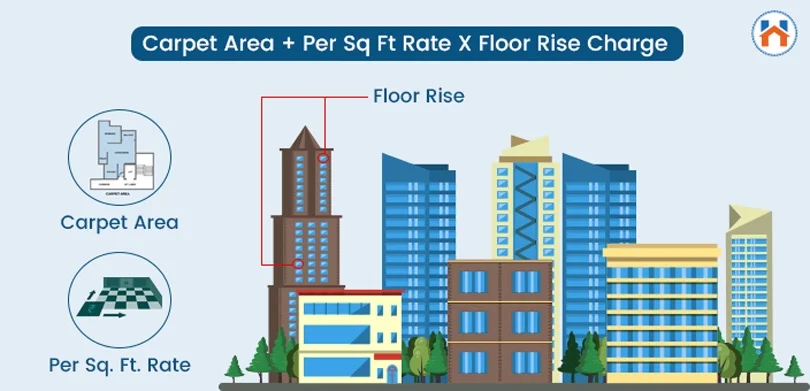
When purchasing an apartment in a high-rise residential project, homebuyers often notice that the price per square foot increases as they move up the building. This incremental cost is known as Floor Rise Charges (FRC). While the base price of a flat remains the same for the structure, the vertical positioning of the unit significantly influences its final market value.
Understanding FRC is vital for accurate budgeting, as it can add several lakhs to the total property cost. This guide explores the definition of floor rise charges, how they are calculated, and their impact on the overall investment.
What is Floor Rise Charge (FRC)?
Floor Rise Charge (FRC) is a premium fee levied by developers for apartments located on higher floors. In most multi-story buildings, units on the upper levels are considered more desirable due to lifestyle advantages such as better views, reduced noise pollution, and enhanced privacy.
Unlike some maintenance fees, the FRC is a one-time capital cost paid at the time of purchase. While it varies by builder and city, it typically begins after a “base floor” (usually the ground or 1st floor) and increases at a fixed rate for every subsequent level.
Why Do Developers Charge for Higher Floors?
There are two primary reasons why units on higher floors carry a premium:
-
Lifestyle Benefits: Residents on higher floors enjoy unobstructed views, better natural light, and superior cross-ventilation. They are also further away from street-level dust and traffic noise.
-
Increased Construction Costs: Building vertically requires more advanced engineering, higher-grade structural materials, and sophisticated vertical transport systems (lifts). Developers use FRC to offset these specialized construction expenses.
How to Calculate Floor Rise Charges
There is no government-mandated standard for FRC, meaning developers set their own rates based on market demand. However, the calculation usually follows a transparent per-square-foot model.
The Standard Formula
The total floor rise cost is calculated by multiplying the rate per floor by the number of floors above the base level, and then applying that to the total area of the unit.
Practical Example
Consider you are buying a 1,000 sq. ft. apartment on the 10th floor.
-
Base Price Floor: Ground Floor (₹0 extra charge)
-
Floor Rise Rate: ₹50 per sq. ft. per floor
-
Number of Chargeable Floors: 10 floors
Calculation:
-
Incremental Rate: $10 \text{ floors} \times \text{₹}50 = \text{₹}500 \text{ per sq. ft.}$
-
Total FRC: $1,000 \text{ sq. ft.} \times \text{₹}500 = \text{₹}5,00,000$
In this scenario, selecting the 10th floor adds ₹5 Lakhs to the base cost of the property.
The Cost Impact: Is It Worth the Premium?
Floor rise charges can increase the total cost of an apartment by 5% to 15%, depending on the height of the building and the city’s real estate dynamics.
-
Initial Budgeting and EMIs: Homebuyers must account for FRC during the initial planning phase. Since the total property value increases, the down payment and the monthly EMI will also rise accordingly.
-
Taxation and Statutory Fees: GST, Stamp Duty, and Registration Charges are calculated on the total consideration value, which includes the FRC. This creates a cascading effect on the final “on-road” price.
-
Investment and Resale Value: From an investment perspective, higher floors often have better liquidity. In the resale market, apartments with panoramic views tend to sell faster. This is a key part of understanding the true cost of buying an apartment in India.
| Floor Level | Pros | Cons |
| Lower Floors | Easy access, lower cost, no FRC. | More noise, less privacy, lower light. |
| Middle Floors | Balanced cost, moderate views. | Average demand in high-rise towers. |
| Higher Floors | Best views, high privacy, cleaner air. | Highest cost, dependence on lifts. |
RERA Guidelines on Floor Rise Charges
Under the Real Estate (Regulation and Development) Act (RERA), transparency is mandatory:
-
Mandatory Disclosure: Developers must clearly state the floor rise charges in the cost sheet.
-
No Hidden Hikes: Once the agreement is signed, the developer cannot arbitrarily increase the FRC.
-
Carpet Area Standard: RERA encourages all charges to be clearly linked to the Carpet Area to ensure buyers know exactly what space they are paying for.
Floor Rise Charges are a standard premium in the modern high-rise landscape. While they represent a significant upfront cost, they offer tangible lifestyle benefits. Before making a booking, buyers should request a detailed cost breakup and evaluate if the advantages justify the expense. For more details on additional premiums, check out our guide on PLC charges in apartments.
Also Read: Understanding Plinth Area: A Comprehensive Guide to Built-up Space and Livability