
Understanding PLC Charges in Apartments
Preferential Location Charges (PLC) are an additional premium that developers charge for apartments with superior positioning within a residential project. These units may offer benefits such as better views, improved natural light and ventilation, or closer proximity to key amenities like parks, clubhouses, or corner locations.
In India’s competitive real estate market, PLC has become a common pricing component alongside the base apartment cost. While the base price may appear attractive, PLC can increase the overall property cost significantly—often adding 2% to 10% or more to the total investment.
For homebuyers, understanding how PLC charges in apartments work is essential for accurate budget planning and smarter property decisions. Evaluating these charges alongside other purchase factors ensures transparency in pricing and helps buyers avoid unexpected costs during the buying process.
Types of PLC Charges in Indian Real Estate
Preferential Location Charges (PLC) can arise from multiple factors within a residential project. These premiums reflect the desirability of certain units based on location, view, orientation, and convenience. In many cases, multiple PLC categories apply simultaneously, increasing the overall cost of an apartment.
1. Floor-Wise PLC (Floor Rise Charges)
Higher floors usually attract additional charges because of better views, privacy, natural light, and reduced street noise. However, pricing varies depending on regional preferences, climate, and project design.
Key Insights
-
Higher floors offer better air quality, ventilation, and panoramic views.
-
Mid-level floors often provide the best balance between cost and accessibility.
-
Ground floors may be cheaper in flood-prone regions but may command premiums if they include private gardens.
-
Penthouses carry the highest PLC due to luxury features and private terraces.
Typical Floor-Based PLC Charges
| Floor Category | Typical PLC Range | Key Reasons |
|---|---|---|
| Higher Floors | ₹50 – ₹100 per sq ft per floor | Better views, air quality, privacy |
| Mid Floors | Minimal or none | Balanced accessibility and value |
| Ground Floor with Garden | ₹150 – ₹300 per sq ft | Private garden and direct access |
| Penthouse | ₹200 – ₹500 per sq ft | Luxury features, private terrace |
2. View-Based PLC Charges
Apartments with superior views command premium prices because aesthetic appeal and lifestyle value significantly influence buyer demand.
Key Insights
-
Green views improve mental well-being and environmental quality.
-
Waterfront properties are among the most premium real estate locations.
-
Internal amenity views offer convenience but may also bring noise.
Typical View-Based PLC Charges
| View Type | Typical PLC Range | Key Benefits |
|---|---|---|
| Park / Garden Facing | ₹150 – ₹300 per sq ft | Green views, tranquility |
| Sea / Water Facing | ₹300 – ₹500+ per sq ft | Premium aesthetics, breeze |
| City Skyline View | ₹100 – ₹250 per sq ft | Urban panorama |
| Amenity Facing (Pool/Clubhouse) | ₹100 – ₹200 per sq ft | Convenience and lively atmosphere |
3. Corner Unit PLC Charges
Corner apartments are highly desirable due to better ventilation, natural lighting, and privacy.
Key Insights
-
Windows on multiple sides improve cross-ventilation.
-
More natural light reduces dependence on artificial lighting.
-
Fewer shared walls increase privacy and reduce noise.
Typical Corner Unit PLC
| Feature | PLC Range | Benefits |
|---|---|---|
| Corner Unit Premium | ₹150 – ₹400 per sq ft | Cross ventilation, natural light, privacy |
4. Orientation and Vastu-Based PLC
In many Indian markets, Vastu Shastra principles influence property demand, which can affect pricing.
Key Insights
-
Preferred directions vary by region and cultural beliefs.
-
Developers often design projects to maximize units with favorable orientations.
-
Vastu-compliant units are often marketed as premium inventory.
Typical Vastu-Based PLC
| Orientation Preference | PLC Range | Common Markets |
|---|---|---|
| East / North Facing | ₹50 – ₹200 per sq ft | Bangalore, South India |
| South Facing | ₹50 – ₹200 per sq ft | Chennai, Tamil Nadu |
| North Facing | ₹50 – ₹200 per sq ft | Delhi NCR |
5. Amenity Proximity PLC
Apartments located close to key amenities within the residential complex often attract additional charges due to convenience.
Key Insights
-
Close proximity to gates can reduce internal travel time in large townships.
-
Units near recreational facilities provide easy access to lifestyle amenities.
-
However, proximity may also bring noise and higher activity levels.
Typical Amenity Proximity PLC
| Amenity Location | PLC Range | Advantages |
|---|---|---|
| Near Main Entrance | ₹75 – ₹150 per sq ft | Faster entry/exit |
| Near Clubhouse / Pool / Gym | ₹100 – ₹200 per sq ft | Convenience for regular users |
| Near Play Areas / Gardens | Variable | Ideal for families |
Key Takeaway:
PLC charges can arise from multiple factors simultaneously, including floor level, views, unit position, orientation, and proximity to amenities. Understanding these categories allows buyers to evaluate whether the premium aligns with their lifestyle preferences and budget before making a purchase decision.
Calculating PLC Charges: Step-by-Step Process
Understanding how PLC (Preferential Location Charges) are calculated helps homebuyers accurately estimate the final cost of an apartment and verify whether the developer’s pricing is correct. In most residential projects, PLC charges are applied using a simple formula, but the total amount can increase significantly when multiple PLC categories apply simultaneously.
Basic PLC Calculation Formula
The standard formula used by developers to calculate PLC charges is:
Total PLC = PLC Rate per sq. ft. × Super Built-Up Area
Key Points to Remember
-
PLC is usually calculated based on the super built-up area, not the carpet area.
-
Super built-up area includes shared spaces such as corridors, lobbies, and common facilities.
-
Multiple PLC factors—such as floor level, view, or corner position—may apply to the same apartment.
-
When several premiums apply, all PLC components are added together to determine the final charge.
Example 1: Single PLC Charge Calculation
Consider a 2BHK apartment in Bangalore with the following details:
-
Super built-up area: 1,200 sq. ft.
-
Base property price: ₹5,000 per sq. ft.
-
Total base cost: ₹60,00,000
-
PLC applied: Park-facing view
PLC Calculation
-
PLC rate for park view: ₹200 per sq. ft.
-
PLC amount: 1,200 × ₹200 = ₹2,40,000
Final Cost Before Taxes
-
Base price: ₹60,00,000
-
PLC charges: ₹2,40,000
Total property cost before GST and other charges: ₹62,40,000
This example shows how even a single location advantage can increase the total cost of an apartment.
Example 2: Multiple PLC Charges on One Apartment
Modern residential projects often apply multiple PLC components simultaneously. For instance, consider a premium apartment with the following features:
-
Super built-up area: 1,000 sq. ft.
-
Located on the 15th floor
-
Park-facing view
-
Corner unit positioning
In this case, the apartment attracts three separate PLC charges.
PLC Breakdown
| PLC Component | Rate per Sq. Ft. | Area | Total Amount |
|---|---|---|---|
| Floor Rise (15th Floor) | ₹75 | 1,000 sq. ft. | ₹75,000 |
| Park-Facing View | ₹200 | 1,000 sq. ft. | ₹2,00,000 |
| Corner Unit Premium | ₹150 | 1,000 sq. ft. | ₹1,50,000 |
| Total PLC Charges | — | — | ₹4,25,000 |
Key Takeaways for Homebuyers
-
Multiple PLC factors can significantly increase the property cost.
-
Premium features such as higher floors, scenic views, and corner units often combine to raise the total price.
-
Always request a detailed PLC breakdown from the developer before finalizing a purchase.
-
Include PLC in your overall financial planning to avoid unexpected expenses during the buying process.
-
Carefully comparing PLC charges across projects can help buyers identify better value properties in competitive real estate markets.
Conclusion:
PLC charges play a crucial role in determining the actual price of an apartment beyond the advertised base rate. Understanding the calculation process and reviewing all applicable PLC components enables homebuyers to make informed decisions, negotiate effectively, and plan their property investment with greater clarity.
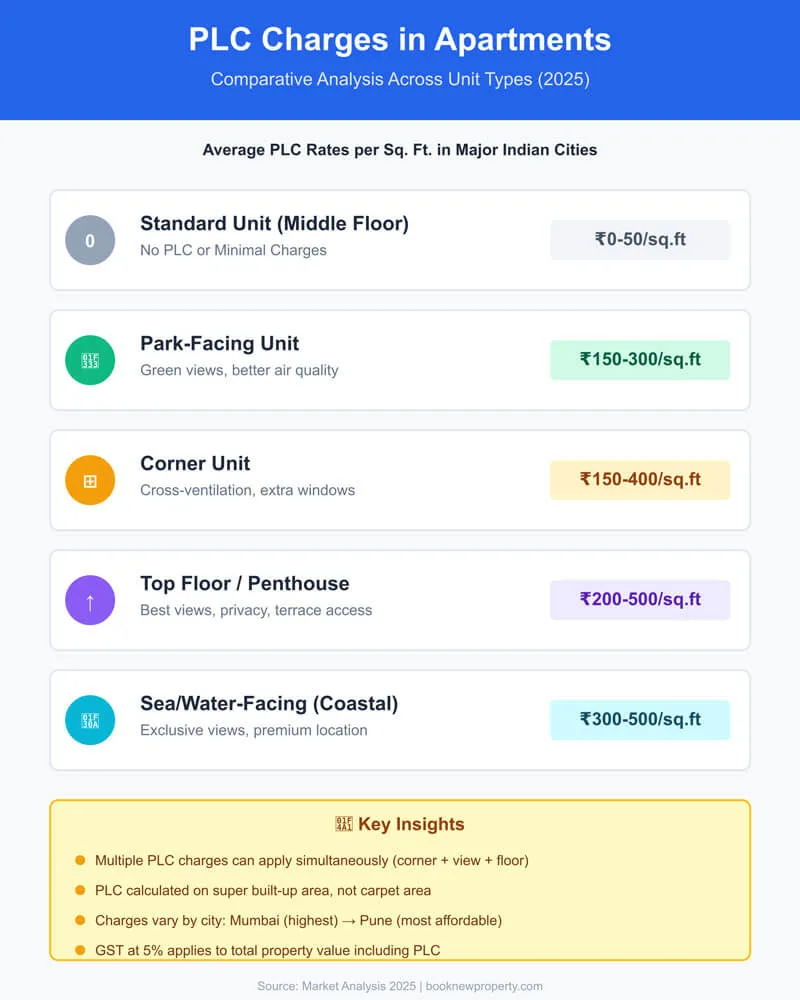
Comparative Analysis Across Unit Types
Floor Rise Charges vs PLC: Key Differences
Understanding the distinction between Floor Rise Charges (FRC) and Preferential Location Charges (PLC) helps homebuyers evaluate property pricing more accurately and identify the true cost of an apartment.
| Parameter | Floor Rise Charges (FRC) | Preferential Location Charges (PLC) |
|---|---|---|
| Definition | Additional charges applied for apartments located on higher floors of a building. | Premium charges applied for apartments with preferred locations or features within a project. |
| Main Pricing Factor | Vertical position (height of the floor). | Location advantages such as views, orientation, corner units, or proximity to amenities. |
| Applicability | Applies only to higher floors above a specified base level (usually 4th or 5th floor). | Can apply to any floor, including ground floor units. |
| Calculation Method | Calculated per floor above a base floor level (e.g., ₹50 per sq. ft. per floor above the 5th floor). | Calculated based on specific location advantages (e.g., park view, corner unit, sea view). |
| Example | A 10th floor apartment may attract FRC for being 5 floors above the base floor. | A ground floor apartment facing a park or garden may attract PLC despite being on the lowest level. |
| Scope | Focuses strictly on elevation within the building. | Covers multiple factors, including views, orientation, floor position, and proximity to amenities. |
| Multiple Charges | Applies only for floor height. | Multiple PLC types can apply simultaneously (e.g., corner + park view). |
| Possibility of Both Charges | May apply together with PLC if the unit is on a higher floor. | Can apply along with FRC if the apartment has additional location advantages. |
Factors Influencing PLC Charges in Indian Cities
Several interconnected factors determine how much developers charge as PLC in different markets, and understanding these dynamics helps you evaluate whether the charges are reasonable or inflated.
Project location and prestige play fundamental roles in PLC determination. Properties in established, high-demand micro-markets of metropolitan cities like South Mumbai, Whitefield in Bangalore, or Gurgaon’s Golf Course Road command significantly higher PLC than projects in emerging or peripheral areas. Luxury developments with branded residences or celebrity architects naturally attract premium PLC rates, sometimes 20 to 50 percent higher than comparable middle-segment projects. The developer’s reputation and track record also influence PLC, with established developers like Prestige Group commanding higher premiums based on brand value and delivery assurance.
Climate and weather patterns significantly impact floor preferences and consequently PLC structures across Indian cities. In Mumbai and Hyderabad, where high humidity levels make ventilation a priority, top floor apartments are highly sought after for their superior air circulation and cooler temperatures. This drives substantial PLC for upper floors. In Delhi, where temperatures swing between extreme summer heat and winter cold, middle floors are often preferred because they’re easier to climate-control and don’t bear the brunt of temperature extremes. Bangalore’s moderate climate allows for more flexible floor preferences, resulting in more balanced PLC distribution across different levels.
The quality of construction, finishes, and amenities directly justifies PLC charges. Projects offering world-class facilities like temperature-controlled swimming pools, professional-grade gyms, landscaped jogging tracks, and smart home automation systems can legitimately charge higher PLC because the overall lifestyle proposition is superior. Sustainability features like rainwater harvesting, solar power integration, and green building certifications are increasingly influencing PLC, particularly among environmentally conscious buyers who value these features.
Market demand and supply dynamics create significant PLC variations even within the same city. During real estate booms, when demand outstrips supply, developers have greater pricing power and limited incentive to negotiate on PLC. Conversely, in slower markets with high unsold inventory, developers may reduce or even waive PLC charges to stimulate sales, particularly during festive seasons or financial year-ends when they need to meet targets. Understanding the best time to book property in Bangalore can give you significant leverage in PLC negotiations.
GST on PLC Charges: Tax Implications for Homebuyers
The taxation treatment of PLC charges has evolved significantly, and recent clarifications have brought greater transparency to how Goods and Services Tax applies to these additional costs.
The 54th GST Council meeting brought crucial clarity regarding PLC taxation. The council determined that PLC forms an integral part of the composite supply of construction services, meaning it should be taxed at the same rate as the underlying property rather than as a separate service. This was a significant relief for homebuyers who previously faced confusion about whether PLC charges in apartments attracted the standard 5% rate applicable to residential properties or the higher 18% rate for separate services. You can find detailed GST rate information on the official GST Council website.
Under the current framework, GST rates vary based on property type and affordability criteria. Affordable housing units, which meet specific price and size criteria set by the government, attract GST at just 1% of the property value including PLC. Standard residential properties under construction face 5% GST on the total value including PLC charges. Commercial properties like office spaces or retail outlets attract 12% GST. Importantly, ready-to-move properties that have received completion certificates are GST-exempt, meaning you pay zero GST regardless of PLC if you’re buying a completed property.
The GST calculation also benefits from land value abatement, a provision that recognizes land itself is not a service and therefore shouldn’t attract GST. The tax framework considers one-third of the total property value (including PLC) as land component, which is GST-exempt. GST applies only to the remaining two-thirds representing construction value. This significantly reduces the effective GST burden on homebuyers.
Let’s illustrate with an example. Suppose you’re buying an under-construction apartment with a base price of ₹50,00,000 and PLC charges of ₹5,00,000, making your total property value ₹55,00,000. The taxable construction value would be 67% of ₹55,00,000, which equals ₹36,85,000. GST at 5% on this amount would be ₹1,84,250. Before the GST Council’s clarification, there was ambiguity about whether PLC would be taxed separately at 18%, which would have resulted in ₹90,000 in GST just on the PLC component—a significant additional burden. The unified taxation treatment has brought much-needed relief and transparency to homebuyers.
PLC Charges Across Major Indian Cities
Regional variations in PLC charges reflect diverse market dynamics, cultural preferences, and climatic considerations across India’s major real estate markets.
Mumbai’s PLC Landscape
Mumbai commands the highest PLC charges in apartments across India, with rates typically ranging from ₹200 to ₹500 per square foot and sometimes exceeding this range in ultra-luxury projects. The city’s space constraints and overwhelming demand for properties with sea views, clear skylines, or proximity to business districts drive these premiums. The humid climate makes top floor units particularly desirable for their superior ventilation, pushing PLC for higher floors substantially above other cities. Even within Mumbai, micro-market variations are significant—South Mumbai properties command far higher PLC than suburbs like Thane or Navi Mumbai, reflecting the prestige and accessibility advantages of central locations.
Bangalore’s PLC Structure
India’s IT capital demonstrates PLC charges ranging from ₹100 to ₹350 per square foot, with significant premiums in technology corridors like Whitefield, Electronic City, and Outer Ring Road where multinational companies cluster. Vastu compliance carries particular weight in Bangalore’s market, with east or north-facing apartments attracting measurable premiums. The city’s moderate climate allows more flexibility in floor preferences compared to Mumbai, resulting in more balanced PLC distribution across different floors. Projects like Prestige Fernvale at The Prestige City in Sarjapur Road and Brigade Avalon in Whitefield exemplify how premium locations command substantial PLC charges. The rapid infrastructure development and metro expansion continuously create new premium micro-markets where PLC structures evolve quickly.
For families seeking value, developments like Brigade Eternia in Yelahanka and Casagrand Estancia in Kogilu offer more moderate PLC structures while maintaining quality construction and amenities. These projects in North Bangalore demonstrate how emerging corridors provide opportunities to secure better units without the extreme PLC charges of established areas.
Delhi NCR’s PLC Pattern
The National Capital Region shows PLC charges ranging from ₹150 to ₹400 per square foot, with substantial variation between Gurgaon, Noida, and Greater Noida. Gurgaon’s established luxury corridors near Golf Course Road and DLF phases command the highest PLC in the region. Interestingly, ground floor apartments sometimes attract premiums in Delhi NCR due to concerns about lift dependency during frequent power cuts and the region’s seismic vulnerability. Properties overlooking golf courses, in gated communities, or near metro stations see particularly high PLC charges.
Hyderabad’s PLC Dynamics
Hyderabad’s real estate market reflects PLC charges ranging from ₹100 to ₹300 per square foot, with premiums concentrated in IT hubs like HITECH City, Gachibowli, and Financial District. The city’s rapid transformation into a major technology center has driven demand for premium apartments among high-earning professionals, supporting substantial PLC charges. Like Mumbai, Hyderabad’s climate makes higher floors desirable for ventilation, influencing PLC structures accordingly.
Pune’s PLC Framework
Pune shows relatively moderate PLC charges ranging from ₹80 to ₹250 per square foot, positioning it as a more affordable option compared to Mumbai while still offering quality infrastructure and employment opportunities. Areas near Hinjewadi IT Park, Magarpatta, and Koregaon Park command higher PLC due to proximity to workplaces and entertainment zones. The city’s large student population and presence of educational institutions create unique demand patterns that influence PLC in certain micro-markets.
Negotiating PLC Charges: Strategies for Homebuyers
While developers set baseline PLC rates, several strategies can help buyers reduce or optimize these charges depending on market conditions and timing. Negotiating PLC charges in apartments requires strategic timing, market research, and understanding developer motivations. However, it’s equally important to avoid common mistakes when investing in a new launch that could compromise your negotiation position or overall investment.
The early launch phase of a project often presents the best opportunities for negotiating lower PLC charges. Developers typically offer attractive pricing during the first few weeks or months of sales to generate momentum and establish market presence. Early bird discounts can effectively offset PLC costs, and developers may be more flexible about customizing packages for initial buyers who help validate their pricing strategy. The first 10 to 20 percent of units sold often have more negotiable terms as developers prioritize building sales velocity over maximizing individual unit margins.
Market slowdowns create buyer-favorable conditions where negotiation leverage increases substantially. When inventory levels are high and demand softens, developers face pressure to meet sales targets and maintain cash flow. During such periods, PLC charges become more negotiable, particularly as financial year-ends approach and developers need to show sales numbers. Seasonal factors like monsoon months or periods following major festival seasons sometimes see reduced demand, creating windows for negotiation.
Presenting comparative market data strengthens your negotiating position significantly. Research PLC charges for similar units in competing projects nearby, and present this information objectively to the developer. When you can demonstrate that comparable properties offer similar features at lower total costs, developers may adjust their PLC to remain competitive. This approach works best when you’re genuinely evaluating multiple options rather than using it as a negotiation tactic alone.
Offering favorable payment terms can sometimes persuade developers to reduce PLC charges. Proposing faster payment schedules, larger upfront amounts, or cash payments that reduce their financing costs and improve liquidity can make you a more attractive buyer. Some developers value certainty and reduced payment risk enough to negotiate on PLC in exchange for assured, timely payments.
However, recognize that certain scenarios offer limited negotiation scope. High-demand luxury projects with strong brand positioning and low inventory rarely budge on PLC charges. Premium micro-markets where demand consistently outstrips supply give developers little incentive to negotiate. Properties from established developers with strong track records and brand equity typically maintain firm pricing structures, including PLC components.
Legal and Regulatory Aspects of PLC Charges
Understanding the regulatory framework governing PLC charges helps protect your interests and ensures transparent transactions. RERA compliance and buyer protection mechanisms provide important safeguards, though buyers must remain vigilant about documentation and disclosures.
The Real Estate Regulatory Authority mandates that all charges including PLC must be disclosed upfront in project advertisements and booking documents. Developers cannot introduce hidden charges after booking, and the cost sheet provided to buyers should detail every component including PLC breakdowns. This transparency requirement enables buyers to make informed decisions and compare projects accurately. Recent developments, such as K-RERA’s warnings against sub-standard handovers, demonstrate regulatory vigilance in protecting homebuyer interests beyond just cost disclosures.
Your sale agreement should clearly specify every PLC charge with transparent calculations showing how rates were applied. The payment schedule for PLC amounts should be defined alongside the base property payment plan. GST treatment of PLC must be explicitly mentioned to avoid disputes later. Any conditions under which PLC might be adjusted should be documented, though post-agreement charge increases are generally not permissible under RERA.
Buyers have fundamental rights regarding PLC charges. You have the right to detailed information including complete cost breakups and justification for PLC amounts. You can question charges that seem arbitrary or excessive and request supporting documentation. If charges weren’t disclosed during booking or if delivered property differs materially from agreement specifications, refund provisions apply under RERA regulations.
Impact of PLC on Property Investment and Resale Value
Understanding how PLC charges affect long-term property value helps you evaluate whether premium locations justify their additional costs from an investment perspective.
Units with PLC advantages often maintain or increase their premium positioning in resale markets. A corner apartment with park views that cost you ₹5,00,000 extra in PLC when new will typically command similar or higher premiums when you sell years later. The features that attracted PLC initially—superior ventilation, aesthetic views, better natural light—remain valuable to future buyers, helping preserve the differential value. In appreciating markets, the percentage premium often stays constant even as absolute prices increase, meaning your PLC investment grows alongside the base property value.
Rental markets consistently favor properties with PLC characteristics. Tenants, particularly corporate relocations or high-income professionals, willingly pay 10 to 15 percent rental premiums for corner units, better views, or higher floors. The combination of lifestyle benefits and status appeal makes PLC apartments easier to rent with shorter vacancy periods. This translates to better returns on investment for landlords, partially justifying the higher initial acquisition cost including PLC.
However, several risk factors deserve consideration. Future construction can obstruct views that commanded significant PLC, potentially eliminating the value proposition you paid for initially. Before committing to view-based PLC, verify the project’s master plan, understand what future construction phases involve, check zoning regulations for adjacent plots, and assess whether your view faces outward toward unbuilt land or inward toward completed project areas. Views facing public parks or water bodies generally carry lower obstruction risk than those facing open plots likely to see development.
Over-leveraging your finances to afford maximum PLC can prove problematic if property appreciation disappoints or if personal circumstances change. Stretching your budget to afford the perfect corner unit on the top floor might seem worthwhile initially, but financial stress from high EMIs or depleted emergency funds can outweigh lifestyle benefits. The premium you paid via PLC needs time to translate into appreciable value, and if you’re forced to sell prematurely due to financial pressure or job relocation, you may not fully recover the PLC investment.
Avoiding Common PLC Mistakes
Learning from frequent buyer errors helps you navigate PLC charges more effectively and avoid costly oversights that many homebuyers make during property purchases.
One critical mistake is failing to verify future construction plans before paying premium PLC for views. Developers might sell you a park-facing apartment on year one, but if phase two of the project includes a tall tower that will block that view in year three, your PLC investment loses much of its value. Always request and review the complete master plan, understand all future construction phases within the project, check municipal zoning and height restrictions for adjacent properties, and document any assurances about view protection in your sale agreement.
Many buyers focus narrowly on one PLC component while overlooking others that collectively inflate the price substantially. You might negotiate hard on the floor rise charge only to accept corner unit and view-based PLC without question. Request a detailed breakup of all applicable PLC charges before signing booking agreements, compare the total PLC against similar units in competing projects, and evaluate whether you truly value all the features attracting PLC or whether some are unnecessary for your lifestyle.
Stretching your budget to the absolute maximum to afford a unit with maximum PLC often backfires financially. Real estate should enhance your life, not create financial stress. Maintain a six-month emergency fund separate from your property investment, keep your home loan EMI below 40 percent of your monthly income to preserve financial flexibility, account for upcoming major expenses like children’s education or medical needs, and ensure you have adequate insurance coverage before committing to maximum PLC units.
Some buyers assume all PLC charges are fixed and non-negotiable, missing opportunities to reduce costs through strategic negotiation. While premium projects might be less flexible, many developers adjust PLC during launch phases, market slowdowns, or when incentivized by favorable payment terms. Research market conditions before negotiations, present objective comparative data from similar projects, time your purchase strategically when developers face sales pressure, and don’t hesitate to walk away if terms don’t align with your budget.
Finally, inadequate attention to legal documentation and agreement terms around PLC can create disputes later. Ensure every PLC charge is clearly itemized in the sale agreement with specific rate calculations documented, verify RERA registration and all disclosed costs match your agreement, understand refund and cancellation terms if the project is delayed or features change, and consider engaging a real estate lawyer to review agreements before signing, especially for high-value properties.
Future of PLC Charges in Indian Real Estate
Several emerging trends are reshaping how PLC charges evolve in India’s dynamic real estate landscape as we move through 2025 and beyond. Infrastructure developments such as Greater Bengaluru Authority’s governance reforms are influencing how micro-markets develop and consequently affecting PLC structures.
Making Informed Decisions About PLC Charges
| Evaluation Factor | With PLC Unit | Without PLC Unit |
|---|---|---|
| Initial Purchase Cost | 5-10% higher than base | Base price only |
| Monthly EMI Impact | ₹3,000-₹8,000 additional | Standard EMI |
| Daily Lifestyle Quality | Significantly enhanced | Standard experience |
| Resale Market Appeal | Generally higher | Moderate appeal |
| Rental Income Potential | 10-15% premium achievable | Market standard rates |
| Total Investment Required | Higher upfront capital | Lower entry barrier |
| Long-term Appreciation | Often proportional to features | Base appreciation rate |
Those interested in exploring luxury villa options in Bangalore or plotted developments like Prestige Autumn Leaves should note that PLC structures in these property types differ from apartments, with emphasis on plot location, corner positioning, and road frontage rather than floor levels.
Conclusion
Preferential Location Charges (PLC) have become a common component of apartment pricing in India, typically ranging from ₹100 to ₹500 per square foot or more in premium projects. These charges reflect the added value of specific advantages within a residential development, such as better views, higher floors, favorable orientation, or corner positioning. Understanding how PLC works—including its calculation, GST implications, regional variations, and negotiation possibilities—helps homebuyers accurately assess the true cost of a property.
Rather than being inherently positive or negative, PLC serves as a pricing mechanism that allows buyers to choose apartments that match their lifestyle preferences and budget. By carefully evaluating these charges, requesting transparent breakdowns from developers, ensuring compliance with RERA guidelines, and negotiating when possible, buyers can make financially sound property decisions while selecting a home that meets their long-term needs.
For comprehensive guidance on navigating the entire home buying process, including PLC evaluation, legal verification, and financial planning, refer to our ultimate 100-point apartment buying checklist to ensure you make informed decisions at every stage.
Disclaimer: This article provides general information about PLC charges in apartments as of December 2025. Property prices, GST rates, and regulatory frameworks may vary by location and change over time. Always consult with real estate professionals, legal advisors, and financial planners before making property purchase decisions. Verify all charges and terms directly with developers and review RERA-registered documentation carefully.
Last Updated: March 2026