
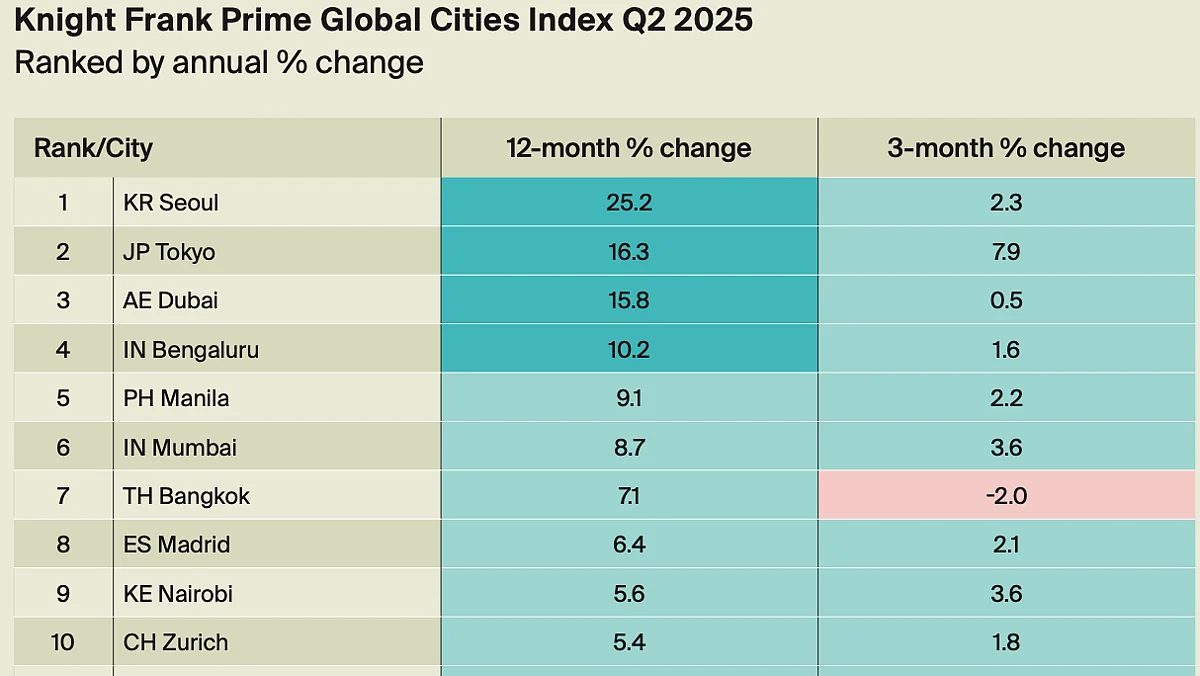
Bengaluru’s prime residential market is emerging as a global hotspot, posting a 10.2% annual price growth in Q2 2025, according to Knight Frank’s Prime Global Cities Index (PGCI). The performance places the city 4th worldwide, surpassing traditional Indian leaders Mumbai (8.7%) and Delhi (3.9%), and highlighting Bengaluru’s rising stature in the international luxury real estate landscape.
Bengaluru’s Strong Momentum
On a quarterly basis, Bengaluru recorded a 1.6% price rise, showing resilience despite global headwinds such as delayed interest rate cuts and tighter financing conditions. Analysts attribute this growth to multiple factors, including expanding metro connectivity, infrastructure upgrades, and large-scale developments like the upcoming Aerospace Park in North Bengaluru.
The city also recorded a landmark 18.2 million sq. ft. of office space absorption in the first half of 2025, driven significantly by global capability centres (GCCs). This combination of infrastructure, employment, and lifestyle is creating a strong demand cycle in both residential and commercial real estate.
Aerospace Park Spurs Growth in the North
A major catalyst for the recent price surge is the Bengaluru Aerospace Park, which has boosted property values in surrounding areas such as Devanahalli, Bagalur, and Shettigere. With the KIADB Aerospace SEZ, Namma Metro expansion, and the upcoming Satellite Town Ring Road, the region is fast transforming into a business and technology hub.
Land and apartment prices have appreciated sharply, with plots witnessing over 20% CAGR in recent years. Developers are capitalizing on this trend: pre-launch allotments near Kempegowda International Airport show one-bedroom apartments priced at nearly ₹1 crore, up from ₹60 lakh just three years ago. Local players like Sattva Group have also announced new projects in Shettigere, with studio units starting from ₹63 lakh and luxury penthouses reaching up to ₹8.6 crore.
Expanding Growth Corridors
Infrastructure projects such as Namma Metro Phase 2 and 3, the Peripheral Ring Road, and the suburban rail network are opening up fresh growth corridors. Key micro-markets benefiting from these upgrades include:
-
Sarjapur–Attibele and Electronic City–Chandapura – attracting end-users seeking connectivity to IT hubs.
-
Extended Whitefield areas toward Kannamangala and Hoskote – gaining traction with robust sales.
-
North Bengaluru (Devanahalli, Bagalur, Doddaballapur) – witnessing increased investor interest due to proximity to the airport.
Bengaluru added 36,200 residential units in H1 2025 (up 11% year-on-year), though sales dipped 12% to 30,120 units. Despite this, prices rose by 12%, averaging ₹8,720 per sq. ft., underscoring sustained buyer confidence.
Dubai: A Parallel Growth Story
Dubai, ranked 3rd on the PGCI with a 15.8% annual price growth, continues to attract global investors through its tax-friendly policies, Golden Visa programs, and strong demand from Europe and Asia. Over five years, Dubai’s property values have soared by 107%, second only to Tokyo’s 120%. Interestingly, in quarterly growth, Bengaluru even outpaced Dubai, securing the 3rd spot globally.
Outlook: Domestic vs Global Drivers
Experts note that while both Bengaluru and Dubai are outperforming global peers, their growth drivers differ. Bengaluru’s surge is largely domestic, fuelled by IT sector expansion, startups, and infrastructure investments, with rising participation from NRIs and institutional investors. Dubai’s growth, on the other hand, is shaped by wealth migration, geopolitical shifts, and international capital inflows.
With global interest rate cuts likely to be delayed, Knight Frank anticipates some cooling across prime property markets. Yet, cities like Bengaluru and Dubai are expected to remain exceptions, driven by strong fundamentals, infrastructure momentum, and unique demand patterns.