The Bangalore Metro Rail Corporation Limited (BMRCL) has unveiled plans for what could be the longest single corridor in the Namma Metro network, proposing a 72-kilometre route with over 50 stations that will expand the city’s rapid transit system and connect major growth corridors.
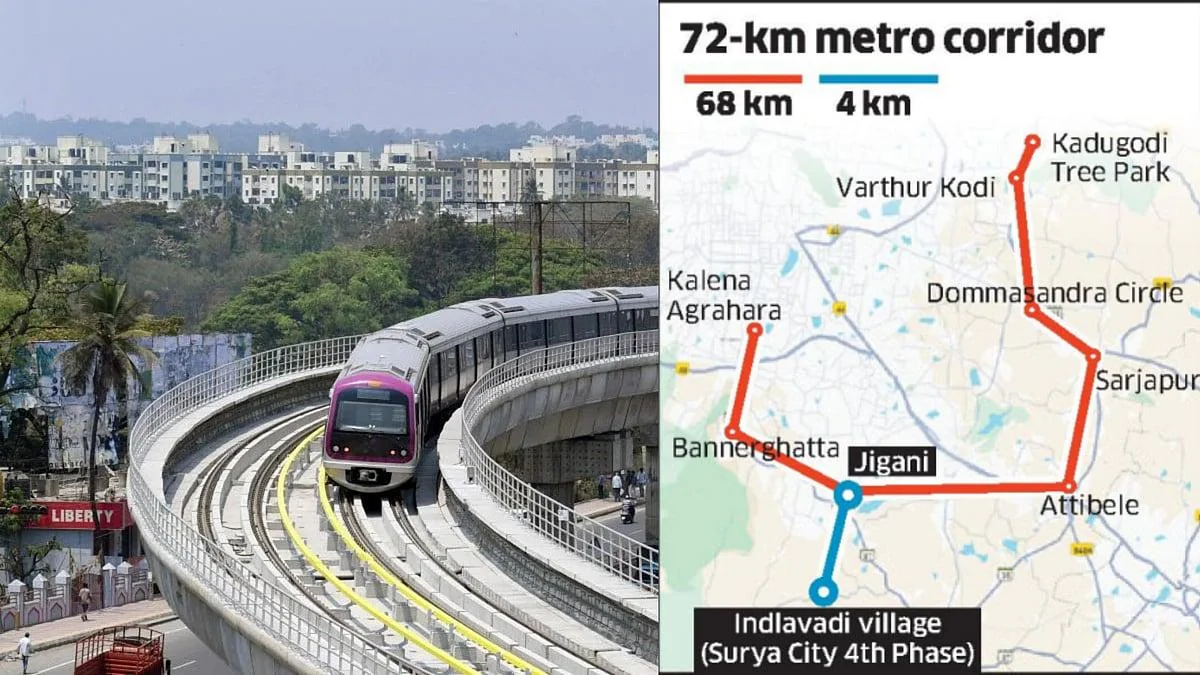
According to official proposals and feasibility reports, the new route will span from the Bannerghatta/Jigani axis in south Bengaluru through emerging suburbs such as Attibele, Sarjapur Road, Dommasandra Circle and Varthur Kodi, ultimately providing connectivity to areas near the proposed international sports complex in Anekal through a planned spur line.
The main portion of the line was initially projected at around 68 km from Kalena Agrahara on Bannerghatta Road to Kadugodi Tree Park near Whitefield, with elevated and underground sections planned along the alignment. A 3.5–4 km spur branch toward the Anekal sports complex has been proposed to connect the rapidly developing sports and recreation hub directly with the metro network, bringing the total stretch to approximately 72 km.
With more than 50 metro stations proposed, this corridor aims to provide expanded accessibility across southeastern Bengaluru, serving key residential, business and industrial areas that have seen rapid urban growth in recent years. The inclusion of the sports complex spur is expected to support ease of access for events and competitions once the facility is completed, enhancing last-mile connectivity without a heavy reliance on road traffic.
The feasibility report for the metro line has been prepared by external consultants and is expected to be submitted to the Karnataka government ahead of detailed project report (DPR) preparation. If approved, the DPR process — which involves cost, technical and environmental assessments — could take about a year, followed by land-acquisition and clearances from both state and central authorities. Construction could begin as early as 2029, with completion possibly following within five to ten years depending on approvals and funding arrangements.
The proposed 72 km corridor forms part of BMRCL’s broader vision to significantly expand Bengaluru’s metro network. When completed, it is expected to improve transit connectivity across the city’s outer and inner suburbs while supporting planned residential and commercial developments. Enhanced public transport infrastructure is seen as critical to reducing road congestion and integrating Bengaluru’s expanding urban footprint.
Also Read: Morgan Stanley Leases Additional 1.6 Lakh Sq. Ft. at Brookfield Ecoworld