
Buying land or a home involves more paperwork than most people expect. Somewhere in that stack of documents, you will likely encounter a term called Floor Area Ratio, or FAR. It sounds technical, but it directly affects how much you can build, how tall a structure can rise, and even how much your property could be worth someday.
Understanding Floor Area Ratio matters whether you are a first-time homebuyer, a builder, or an investor scouting land. This guide breaks down the concept in plain language. We will cover how FAR is calculated, why municipalities regulate it, and how it influences real estate decisions. By the end, you will know exactly what to check before signing any property deal.
What Is Floor Area Ratio?
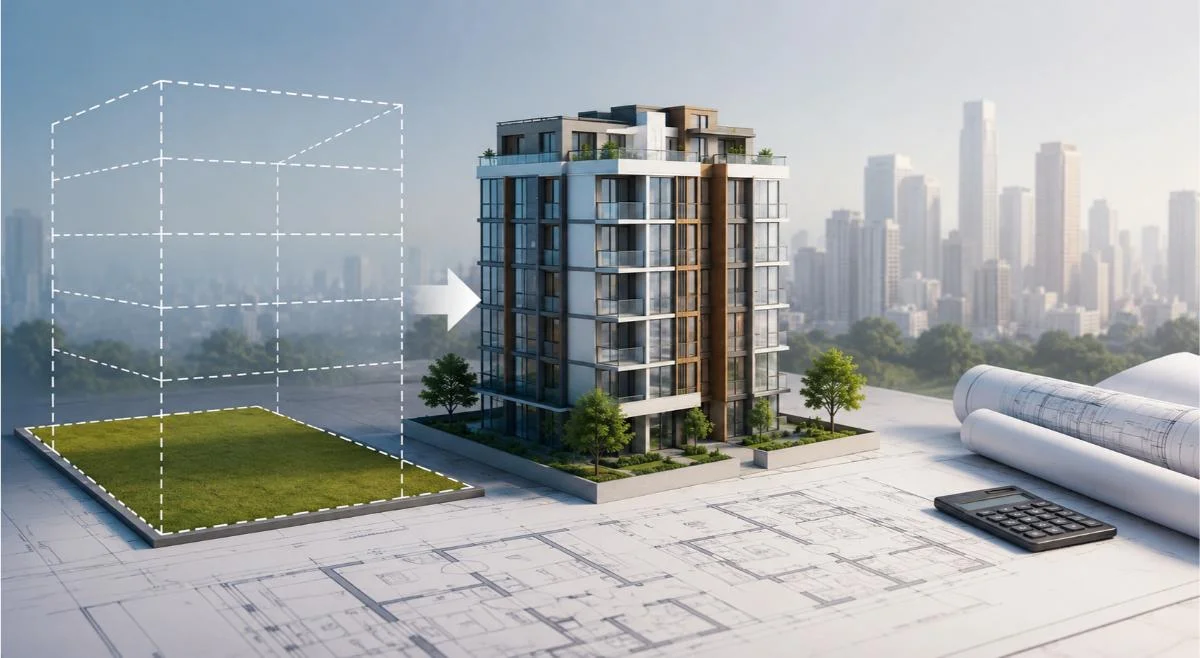
Floor Area Ratio is the relationship between the total built-up area of a building and the size of the plot it stands on. In simple terms, it tells you how much construction is legally allowed on a piece of land.
Here is the basic formula:
FAR = Total Built-Up Area ÷ Total Plot Area
For example, if a plot measures 2,000 square feet and the local FAR limit is 1.5, the owner can construct up to 3,000 square feet of built-up space. That space can be spread across one floor or multiple floors, depending on other zoning rules like height restrictions and ground coverage limits.
Municipal authorities set FAR limits based on infrastructure capacity, population density, and urban planning goals. Consequently, FAR values vary significantly from one city to another, and even between neighborhoods within the same city.
Why Does FAR Exist in the First Place?
City planners do not pick FAR numbers randomly. They consider several practical factors before deciding how much construction a plot can support.
- Infrastructure capacity: Roads, water supply, and sewage systems can only handle a certain population density.
- Traffic management: Higher FAR means more residents or occupants, which increases vehicle load on nearby roads.
- Sunlight and ventilation: Lower FAR in residential zones helps maintain open spaces between buildings.
- Emergency access: Fire trucks and ambulances need adequate space to maneuver, so unchecked density is discouraged.
As a result, FAR acts as a balancing tool. It allows cities to grow vertically without overwhelming existing infrastructure.
How Floor Area Ratio Affects Property Value
Here is where FAR becomes genuinely important for buyers and investors. A plot with a higher FAR allows more construction, which usually translates into higher potential value. Builders can construct more saleable area on the same land, which improves profitability.
For instance, two adjacent plots of identical size may carry different price tags simply because one has an FAR of 2.0 and the other has an FAR of 1.2. The plot with higher FAR offers more construction potential, making it more attractive to developers.
Similarly, government bodies sometimes offer premium FAR, allowing builders to construct beyond the standard limit by paying an additional fee. This practice, known as purchasable FAR or premium FDR in some regions, has become common in fast-growing cities facing land scarcity.
FAR and Redevelopment Projects
Redevelopment projects rely heavily on FAR calculations. Older buildings, especially in cities like Mumbai, Delhi, and Bengaluru, often occupy plots where current FAR limits are higher than what was originally used decades ago.
This gap creates an opportunity. Developers can demolish the old structure and rebuild with significantly more floor space, benefiting both residents and builders. Therefore, understanding current versus historical FAR limits helps buyers evaluate redevelopment potential before investing.
Floor Area Ratio vs Floor Space Index (FSI)
Many people use FAR and FSI interchangeably, and in most practical contexts, they mean the same thing. However, some regions apply subtle differences in how each term is calculated or regulated.
| Aspect | Floor Area Ratio (FAR) | Floor Space Index (FSI) |
|---|---|---|
| Common Usage | United States, UK, global standard | India, especially in official land records |
| Calculation | Built-up area ÷ Plot area | Same formula, regional terminology |
| Regulatory Body | Local municipal zoning boards | State urban development authorities |
| Typical Range | 0.5 to 3.0, varies widely | 1.0 to 4.0, varies by city zone |
In India, FSI is the term commonly used in official documents, while FAR remains popular in international real estate literature. Regardless of terminology, the underlying concept stays the same: it defines how much you can build on your land.
Factors That Influence FAR Limits
Several variables determine the FAR sanctioned for a specific plot. Recognizing these factors helps buyers understand why FAR differs so much across locations.
- Zoning classification – Residential, commercial, and industrial zones each carry different FAR allowances.
- Road width – Plots facing wider roads typically receive higher FAR due to better traffic absorption capacity.
- City master plan – Urban development authorities revise FAR periodically based on long-term growth strategies.
- Proximity to metro corridors – Many cities now offer FAR incentives near transit stations to encourage transit-oriented development.
- Green building certifications – Sustainable construction sometimes qualifies for additional FAR benefits.
Meanwhile, some cities also allow Transferable Development Rights, letting landowners sell unused FAR to developers elsewhere. This mechanism helps preserve heritage structures while still rewarding owners financially.
How to Calculate FAR for Your Property
Calculating your allowable FAR is straightforward once you know your plot area and the sanctioned ratio for your zone. Follow these steps:
- Check your city’s zoning map or contact the local development authority.
- Confirm the sanctioned FAR for your specific plot category.
- Multiply your plot area by the FAR value to get maximum permissible built-up area.
- Subtract mandatory setbacks and open space requirements before finalizing your building plan.
For example, a 1,000 square foot residential plot with an FAR of 1.5 permits 1,500 square feet of construction. If the plot allows a two-story structure, each floor could average around 750 square feet after accounting for staircases and common areas.

Common Mistakes Buyers Make With FAR
Many buyers skip verifying FAR before purchasing property, which can lead to costly surprises later. Here are frequent errors worth avoiding.
- Assuming the builder’s marketing brochure reflects actual sanctioned FAR.
- Ignoring local FAR revisions that may reduce future redevelopment potential.
- Overlooking additional FAR charges for premium construction rights.
- Failing to confirm whether balconies and parking areas count toward FAR calculations.
Nevertheless, a quick visit to the municipal office or a conversation with a knowledgeable property consultant can clear up most confusion.
FAR in Commercial Real Estate
Commercial properties often carry higher FAR limits compared to residential zones, since office buildings and retail spaces generate different infrastructure demands. Business districts in major cities frequently see FAR values between 2.5 and 4.0, allowing skyscrapers and large commercial complexes to rise on relatively compact plots.
Investors evaluating commercial land should always cross-check FAR against projected footfall and parking requirements. In contrast, industrial zones typically maintain lower FAR values due to space needed for machinery, storage, and safety buffers.
Frequently Asked Questions
1. What is a good Floor Area Ratio for residential property?
A residential FAR between 1.0 and 2.0 is common in most cities, though this varies based on zoning and infrastructure. Higher FAR generally suits urban cores, while suburban areas maintain lower limits.
2. Can FAR be increased after construction?
Generally, no. Once a structure is built according to sanctioned FAR, increasing it requires demolition and reconstruction, or in some cases, purchasing additional premium FAR before starting new construction.
3. Does FAR include parking area?
This depends on local regulations. Many cities exclude covered parking and stilt areas from FAR calculations, though rules differ across states and municipalities.
4. Is FAR the same across all cities?
No, FAR varies significantly based on zoning laws, road width, population density, and city-specific urban development plans. Always verify the exact FAR applicable to your plot.
5. How does FAR affect property resale value?
Higher unused FAR often increases resale value because it signals redevelopment potential. Buyers and developers pay a premium for plots offering additional construction rights.
6. What is premium FAR?
Premium FAR allows builders to construct beyond the standard sanctioned limit by paying an additional fee to the local development authority, subject to specific conditions.
7. Where can I check the FAR for my property?
You can check FAR details through your local municipal corporation, development authority website, or by consulting a licensed architect familiar with your city’s zoning regulations.
Floor Area Ratio might seem like a technical detail buried in property documents, but it shapes nearly every aspect of real estate value and development potential. Whether you are buying a home, investing in land, or planning a redevelopment project, checking the applicable FAR should be one of your first steps.
Overall, a clear understanding of Floor Area Ratio helps you make informed decisions, avoid legal complications, and identify properties with genuine long-term value. Before finalizing any deal, always verify FAR limits with local authorities and cross-check builder claims against official records.


