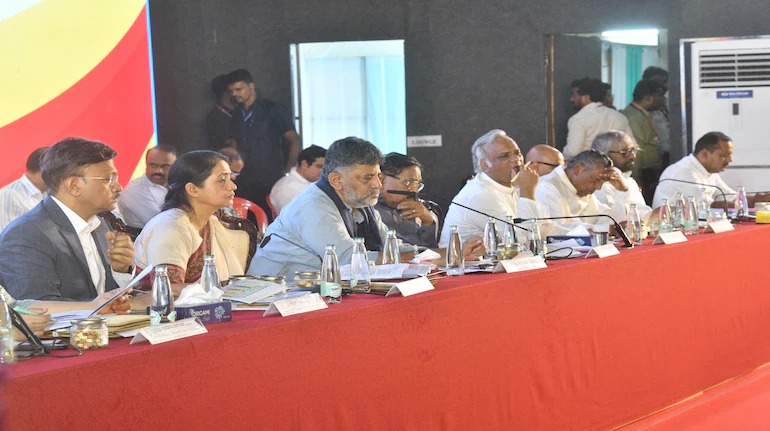
BENGALURU– The Karnataka state government has announced a major policy shift aimed at boosting economic growth beyond Bengaluru. Chief Minister D.K. Shivakumar stated that the government will offer a significantly higher FAR in tier-2 and tier-3 cities across the state. This strategic decision seeks to attract industrial investments, lower infrastructure costs for businesses, and systematically curb rural-to-urban migration.
By amending existing urban development laws, the state plans to incentivize companies to set up operations in expanding rural clusters. Consequently, local youth will find robust employment options within their home districts, easing the developmental pressure on the state capital.
Reforming Floor Area Ratio Norms Beyond Bengaluru
To make cities like Kalaburagi, Hubballi-Dharwad, Mysuru, Belagavi, and Mangaluru highly lucrative for commercial entities, the government is modifying zoning rules. Specifically, the state will provide a premium Floor Area Ratio (FAR) concession of 0.6 times and formally permit up to double (2x) the standard FAR for upcoming developments.
Land acquisition is significantly more affordable in these regional hubs than in the highly saturated micro-markets of Bengaluru. By granting a higher FAR in tier-2 and tier-3 cities, the state enables industries to maximize vertical development at lower costs. The Urban Development Department will shortly introduce the necessary legislative amendments to formalize this structural template.
Integrating Rural Education and Skill Portals
Alongside commercial incentives, the state government is pursuing a parallel social infrastructure strategy. The Chief Minister announced a new educational policy to construct 2,000 model schools at the gram panchayat level using Corporate Social Responsibility (CSR) funding. Under this framework, corporate groups will invest ₹10 crore to ₹15 crore each to directly build school infrastructure instead of handing capital over to public authorities.
Moreover, the government is launching “Yuva Udyoga Setu,” an online private-sector employment exchange. This digital application will function as a bridge connecting certified job-seekers with verified commercial enterprises. The state’s Skill Development Department will manage specialized technical training programs to align regional candidates with industry requirements.
“Our core objective is to encourage industries in tier-2 and tier-3 cities to create immediate employment opportunities,” stated Chief Minister Shivakumar during a progress review briefing. He added that the state will advise companies to give a healthy preference to local candidates following custom management-level discussions.
Ultimately, this dual focus on real estate optimization and localized workforce development aims to distribute economic wealth evenly. By executing these ambitious urban planning models, Karnataka seeks to build competitive industrial alternatives that safeguard rural communities and promote balanced regional development.
Also Read, Sobha Ltd Establishes Strong Foundation for FY27 Following Record Q1 Sales Bookings