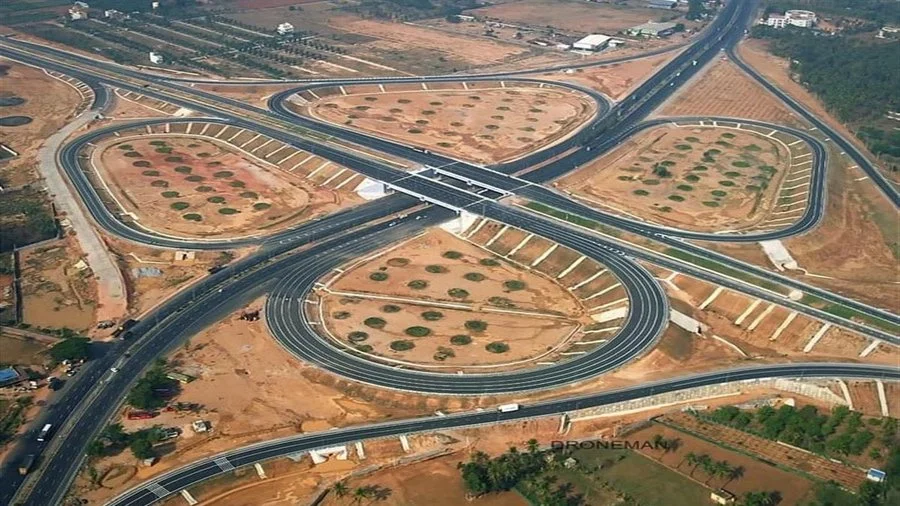
The Ministry of Environment, Forest and Climate Change (MoEFCC) has granted environmental clearance to the Bangalore Development Authority (BDA) for the proposed Peripheral Ring Road (PRR) in Bengaluru. The project, planned as an eight-lane arterial corridor, will connect Tumakuru Road in the north-west to Hosur Road in the south-east, forming a crucial outer mobility network for the city.
This clearance is a key regulatory step that enables the project to progress toward execution, including land acquisition and detailed planning phases. The PRR has been under consideration for several years as part of Bengaluru’s long-term infrastructure roadmap. In fact, the PRR-1 implementation stage has already begun with the release of tenders for the initial 19.8 km stretch connecting Tumakuru Road to Airport Road
Why the Peripheral Ring Road Matters
The PRR is designed to ease congestion within the city by diverting heavy and through-traffic away from core urban roads. As Bengaluru continues to expand, existing transport infrastructure has faced increasing pressure, particularly along key corridors connecting different parts of the city.
By creating a high-capacity bypass route, the project aims to improve travel times, reduce bottlenecks, and strengthen connectivity between major highways and economic zones. This mirrors other major efforts like the 11 newly approved elevated corridors intended to provide signal-free transit across high-density routes.
Project Snapshot
The proposed corridor will serve as a strategic link between multiple national and state highways. It is expected to integrate with existing road networks and upcoming infrastructure developments, supporting smoother vehicular movement across regions.
Key Details at a Glance
- Project: Peripheral Ring Road (PRR)
- Implementing Body: Bangalore Development Authority (BDA)
- Approval: Environmental clearance by MoEFCC
- Road Configuration: 8 lanes
- Route Coverage: Tumakuru Road to Hosur Road
- Primary Goal: Traffic decongestion and improved connectivity
Real Estate and Development Implications
Infrastructure approvals of this scale often have a direct influence on surrounding land markets. The PRR is expected to unlock development potential in peripheral areas by improving accessibility to previously less-connected zones. This is already evident in micro-markets like Thanisandra, where prices have reached ₹12,000/sq. ft. in anticipation of improved connectivity.
Real estate activity may see increased traction along the proposed alignment, particularly in segments suited for residential layouts, logistics parks, and commercial developments. To address this rising demand, the BDA is planning over 4,200 new flats across key growth corridors. Improved connectivity typically supports expansion of urban boundaries and encourages the growth of satellite hubs.
Additionally, the project could enhance the attractiveness of North and South Bengaluru for long-term investments, especially in areas that benefit from proximity to the new corridor.
Project Overview Table
| Aspect | Information |
|---|---|
| Project Name | Peripheral Ring Road (PRR) |
| Authority | BDA |
| Clearance Granted By | MoEFCC |
| Road Type | Eight-lane arterial road |
| Coverage | Tumakuru Road to Hosur Road |
| Key Benefit | Reduced congestion, improved connectivity |
What Lies Ahead
With environmental clearance now secured, the project is expected to advance toward implementation stages, subject to statutory processes and timelines. The PRR forms a critical part of Bengaluru’s broader urban planning strategy aimed at supporting future population and economic growth.
As infrastructure development continues to shape the city’s expansion, projects like the Peripheral Ring Road are expected to play a significant role in enhancing mobility and enabling balanced urban development.
Also Read: Exide Energy Sets Up Manufacturing Plant at KIADB Aerospace Park Phase 2 in North Bengaluru